













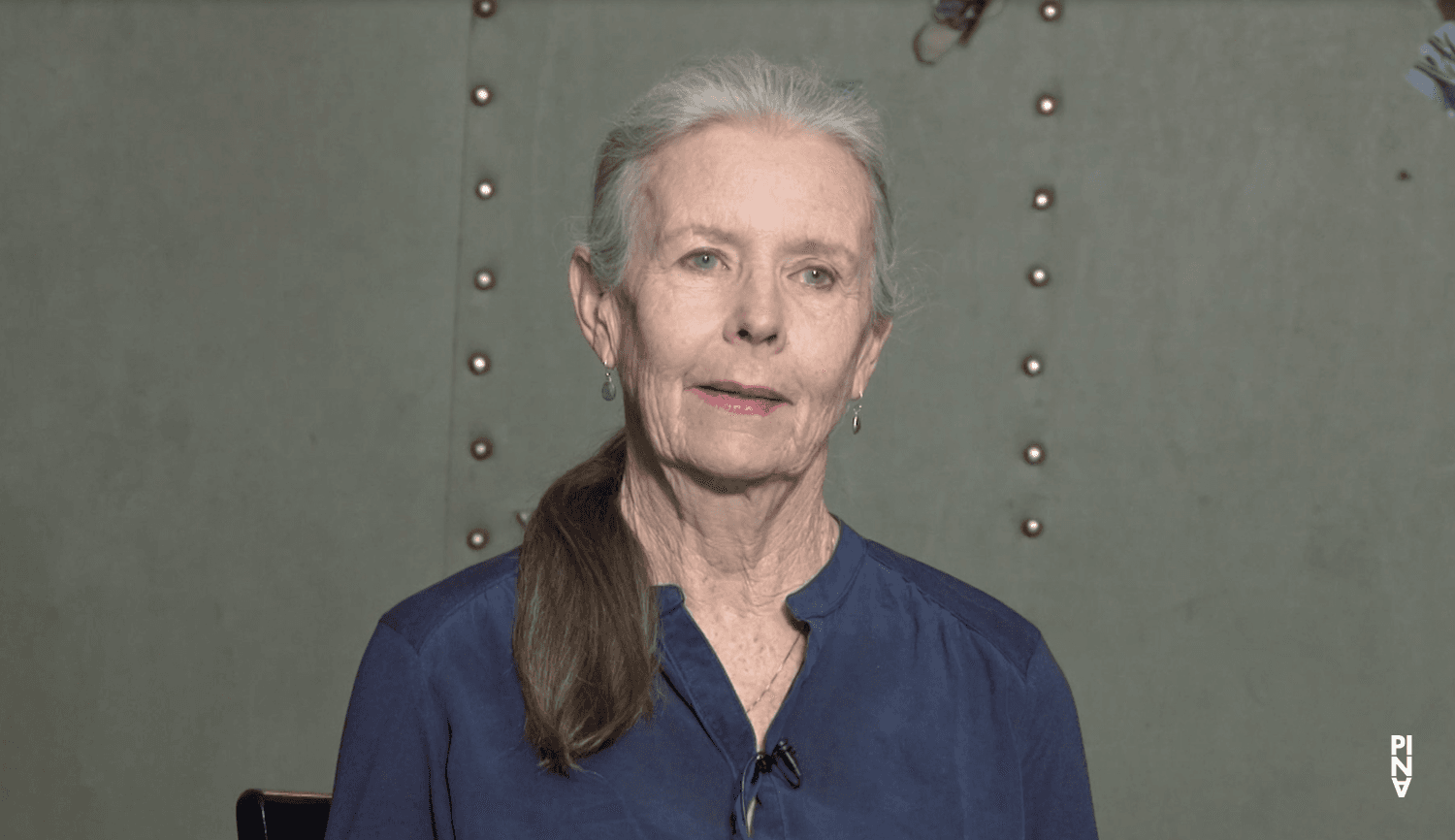
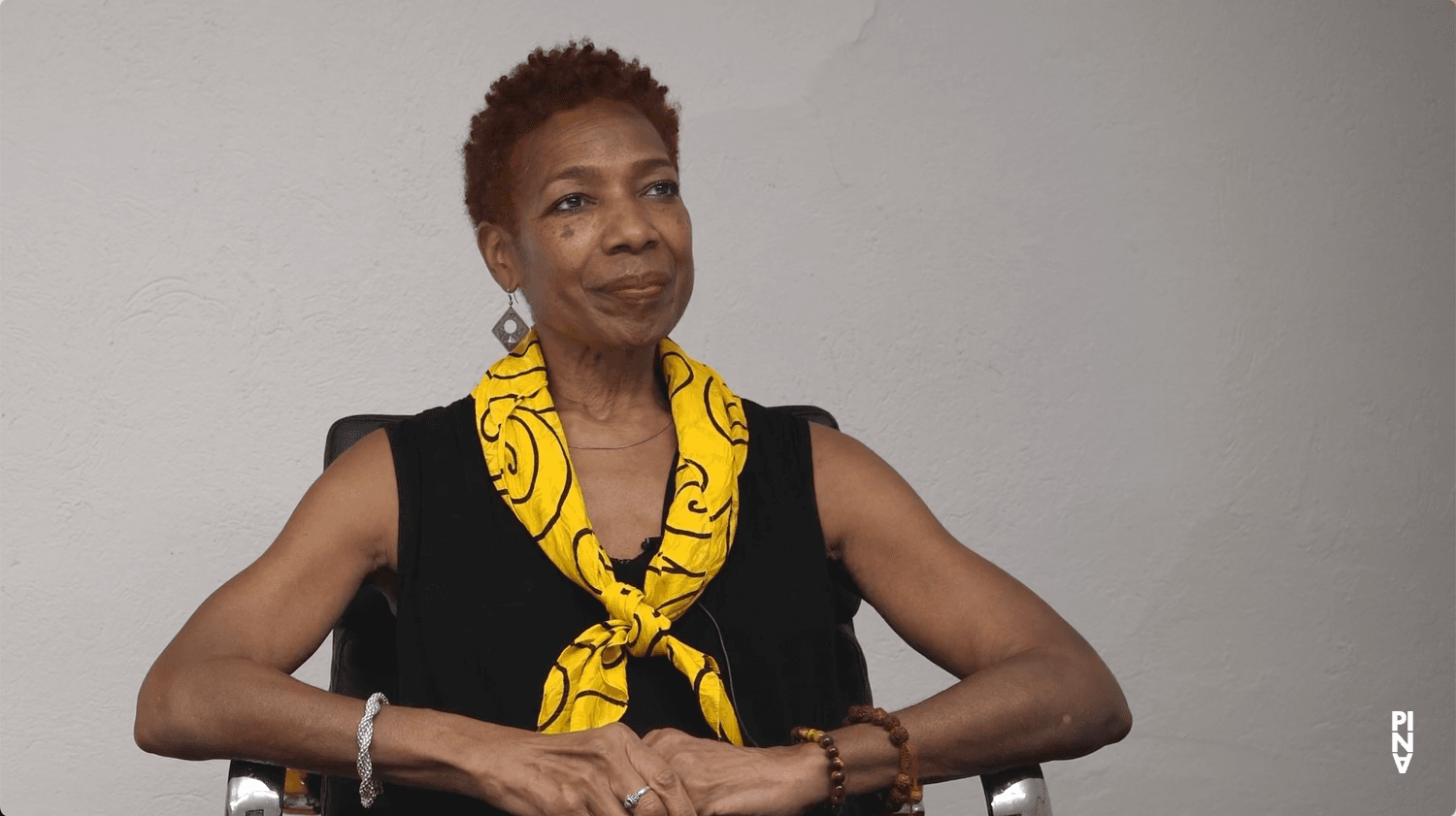
Interview with Anna Wehsarg, 22/4/2024
Anna Wehsarg belongs to the last generation of dancers who worked directly with Pina Bausch. In this conversation, she describes her journey from classical ballet, through the school of Maurice Béjart, and finally to Wuppertal – where she encountered a completely new way of dancing and creating art.
She explains how Pina’s work was both highly precise and deeply personal. From the outside, the pieces often appeared free and improvised, yet behind the scenes every detail was carefully crafted. This unique combination of rigour, openness and trust shaped Anna’s entire time in the company.
Guest performances on major stages around the world and numerous co‑productions played a central role in her experience with the Tanztheater Wuppertal Pina Bausch. Through these travels she learned to translate impressions from different cultures into her own, personal movement language. She also reflects on how the period after Pina’s death – the making of the film Pina and the intense London season in 2012 – brought the group together in a new way.
Today, Anna works as a pedagogue and passes on what she learned from Pina: to stay curious about people, to look closely at what each person brings, and to create something new together. Her memories capture decades of Pina’s artistic practice with a clarity that only someone who lived through that time can offer.
| Interviewee | Anna Wehsarg |
| Interviewer | Ricardo Viviani |
| Camera operator | Sala Seddiki |
| Video edit | Jonathan Rösen |
Permalink:
https://archives.pinabausch.org/id/20240422_83_0001
Table of contents
Chapter 1.1
Wuppertal Opera houseRicardo Viviani:
Anna, the Opernhaus — do you have special memories from here, the Opera House, but also from the Schauspielhaus? What are your memories of these two venues?
Anna Wehsarg:
What are my recollections of the Opera House? We performed many, many shows here. When I arrived in 2000, I auditioned here — it was a private audition. I came in, and Pina Bausch watched me during the classical morning training session. That was still the old ballet studio; the Opera House had not yet been renovated as it is now, with such a large ballet studio. It was a very small studio back then. I remember very clearly how difficult it was to find my way around — there are so many twisting corridors here. I can still picture that day: doing classical training in that small studio while Pina sat on the floor watching.
Yes, personally, I always preferred performing at the Schauspielhaus a little more than at the Opera House. I found the building very beautiful, and the stage was lovely. The cafeteria at the Schauspielhaus was always very nice as well. And somehow, because it is more central in Elberfeld, it felt more connected. I also liked the stage and the audience profile there better.
Ricardo Viviani:
Do you have the feeling that, when you were in the Schauspielhaus, it was more intimate? Because here in the Opera House there is so much activity — the orchestra, the opera. Was there more private time in the Schauspielhaus?
Anna Wehsarg:
No, not quite. I never actually heard much from the other departments when we were here at the Opera House. Most of the time, whenever we were on stage or preparing our shows, there was no one else around. Back then, when I started in 2000, we trained in the ballet studio and then went straight over to the Lichtburg to work. We never rehearsed in the ballet studio. It was used as an extra space — for someone who needed to learn something separately, or when rehearsals overlapped. That’s why I didn’t hear much of what else was happening here. That was simply our routine: we were either here, or we were at the Schauspielhaus.
Anna Wehsarg:
I was born and grew up in Essen, and my mother sent me to ballet lessons quite early on — I must have been four or five. I still remember the teacher very well; he was a man, very strict, but I somehow enjoyed it. I loved going there, although I did many other things during my childhood. I was a competitive swimmer for many years, with training three or four times a week and regular competitions at weekends.
As I got older and started high school, there was a ballet group and a jazz group, and I took some dance courses there. That’s when I realised I preferred dancing to swimming, so I stopped swimming and had more time for dance lessons. I did ballet, then jazz, and later took more classes elsewhere. That’s how it all began.
Ricardo Viviani:
For your further studies, did you choose dance as a professional goal?
Anna Wehsarg:
I don’t come from a family of artists. My mother is a housewife, and my father worked for an electricity supplier in Essen back then. When I realised that I simply wanted to dance more — preferably all the time, and not go to school at all — the big question was: how does that work? We weren’t even sure it existed as a profession.
We went to the theatre regularly. I used to watch the ballet in Essen perform; the ballet director was Heidrun Schwaarz. That was my theatre. As I watched everything, I thought to myself: ‘Yes, there are professional dancers, it is a profession. Maybe I’d like to do that. But how?’ That wasn’t clear.
And then I was very lucky. When I was twelve or thirteen, I went to a class at the music school in Essen. The teacher was pregnant, and a substitute came in — a teacher I’m still in contact with, Pilar Buira Ferre. She now lives in southern Germany and runs a cultural centre there. She was a very young woman who gave wonderful classical lessons. She alternated each week: one week classical ballet, the next week modern dance. I took her classes once a week.
She then said, ‘I think this makes sense for you. You’re talented.’ And she was able to give me advice on how I could pursue it professionally and what was available. Then I sat down with her and my mother, and we talked about what I wanted and how to go about it.
I wanted to leave school after the tenth grade — my parents were not very enthusiastic about that. I wanted to go to school in Hamburg. I definitely wanted to be a classical ballet dancer; that was my big goal. And then my parents said, ‘Well, do the admission audition, and if it doesn’t work out, then you can try something else.’
In Essen, there is the Arts High School in Essen-Werden. They have very good dance training alongside regular academic lessons. Nowadays, they even have an advanced dance course — the Leistungskurs — and it has all developed further. Back then, it was a little less so, but still with very good lessons. So I said, ‘Okay, let’s do it this way.’
And then I wasn’t accepted in Hamburg. My parents were very happy about that, and I changed schools and went to the Gymnasium Essen-Werden. At that time, the Gymnasium Essen-Werden focused on classical ballet, while the Folkwang University offered dance in a very modern and contemporary way. I continued my ballet education at the high school. I looked into Folkwang from time to time and took some lessons there too, but I actually wanted to dance classical ballet.
When I was fifteen, I saw a piece by Maurice Béjart and found it very beautiful — especially because he had very tall women in his ballets. I am very tall. I kept growing past the line drawn on the door frame where we had marked the limit of 1.68 metres for a classical ballet dancer. So I thought, ‘Oh dear, what now?’
And when I saw a piece by Béjart in Recklinghausen, at the Ruhrfestspiele, I said, ‘Oh, that’s maybe someone I could work with.’ When Maurice Béjart won the German Dance Prize in Essen in 1994, I watched the evening when his company performed. He also gave a talk, of course. And there was a commemorative publication in addition to the evening programme. In that publication, there was an article about his school in Lausanne, the École-Atelier Rudra Béjart. Back then, there was no Internet to research anything, so this was a stroke of luck.
I thought, ‘Oh, he has a school — I’ll apply when I finish school here.’ Then I finished my final exams — the Abitur — and I auditioned, and he actually accepted me. And so I continued my studies with Béjart.
Chapter 1.3
École-Atelier Rudra Béjart LausanneRicardo Viviani:
A big leap from Germany to Switzerland. How was school? What did they study there in Rudra? What kind of ballet, what kind of other stuff?
Anna Wehsarg:
So, what really impressed me about it was that the school had a lot of subjects — not just classical dance. We always started with ballet; we had classical dance, pas de deux, but then also theatre, singing, flamenco, Indian dance, African dance. There were always different theatre teachers, from London and so on, and we also had to learn the Japanese martial art of Kendo. We had really intensive Kendo — three times two hours a week — and that was very demanding.
Back then, the study period was only two years, and I did that. The school is in the same building as the company. It is a large building complex with four studios. The company works in two studios and the school in the other two. We were often cast in his pieces whenever they needed people. All the girls and boys were used for his Le Sacre du printemps. He always had very, very large groups. He really liked to create big spectacles.
Yes, it was a very intensive time — many hours of lessons each day and a very varied programme with singing, acting, and so on.
Ricardo Viviani:
How was your contact with Maurice Béjart?
Anna Wehsarg:
He was always there, so we always saw him. Back then, he chose his students for the school himself at the audition. The audition was structured so that you had to dance a solo first, and he watched it. He looked very carefully at everyone and then decided whom he would take. You would see him in the corridor, and he would greet you. And he always spoke to me in German. His father was a philosopher, and he really, really liked the German language. Whenever he spoke to me, he tried to speak in German. Sometimes he even lent me books about German expressive dance and so on, which he kept in his office.
Yes, that was the contact. He was actually very friendly, but I was incredibly shy. He was such a big man, and such an artist. I was really shy around him. But it was a very nice contact, and I wanted to keep dancing with him. I wanted to stay in his company.
Then I had a conversation with him when it became clear that the young company would be disbanded. He told me that he thought I wouldn’t be happy with him, because the women didn’t do that much — I think he phrased it a bit differently — but his focus was on the men. And he said he wouldn’t like to take me into the ensemble because he knew I would be underwhelmed. He told me: ‘It would certainly be good for you to work with someone like Pina Bausch or Maguy Marin.’ And I just thought: ‘What? I didn’t do all this ballet and pointe‑shoe work to now be contemporary.’ That was my first thought. ‘Oh, okay.’ As it was, I had to go anyway, because I couldn’t stay there, and then I went back to Essen. That was 2000.
Ricardo Viviani:
That’s three or four years, right?
Anna Wehsarg:
I spent three years with Béjart and then came back and immediately came here to Pina. There was only the summer when I didn’t have a job.
Ricardo Viviani:
After these years in Switzerland, you came back to Germany. In your time in Switzerland, did homesickness also play a role?
Anna Wehsarg:
No, I wasn’t homesick at all. I enjoyed dancing so much; most groups I found interesting were abroad. I actually really liked the idea of going to a foreign country, living and working there. I found that very nice. Having to leave because I didn’t have a job was a bit sad. I also had to do auditions, so I did a lot of different auditions. I wasn’t homesick, no, I would have liked to stay abroad.
Chapter 2.1
Audition Tanztheater WuppertalRicardo Viviani:
Of course, when you studied in Essen‑Werden, Pina Bausch was a household name and well known. After this time in Switzerland, you started auditioning. How did you come to an audition here in Wuppertal?
Anna Wehsarg:
So I started auditioning while I was in Switzerland. You always do that the year before you stop working. And there was an audition for Tanztheater Wuppertal Pina Bausch in Paris. I signed up because a lot of people told me: ‘That would suit you very well.’ But I was unsure, I thought: ‘Yes, I am not sure, I actually want to dance in classical or neoclassical ballet.’ I didn’t know anything about Pina. I hadn’t seen anything before, not a single piece. I watched some videos, and there was a documentary that was on TV back then. We’re still talking about times when there wasn’t Internet to research. All we could see was what was shown on TV, and there was this documentary. Of course, there were always reports every year about her new pieces in the dance magazines. I thought I don’t know, I’ve seen pictures of women with long wet hair, in short dresses, barefoot. I really thought, ‘I don’t know if I can or if I want to.’
Regardless, I had to find a job. So I applied for the audition in Paris and went to it. It was a very nice audition. We did a classical ballet class together, Alfredo Corvino was teaching. And after that, Pina chose who would stay and she didn’t choose me. But then she told us, in her usual way, that she was looking for very specific people and ‘that has nothing to do with your skills or how you are or who you are. Don’t be harsh on yourselves, but she is looking for very specific types and if you’re not selected now, that’s just because you’re not the type she’s looking for.’ I drove back home and thought, okay, done. Then I just kept trying somewhere else.
When I came back to Essen, a former teacher of mine from high school asked me: ‘What are you doing now?’ I said, ‘I am looking around.’ And then she said: ‘They’re looking for a big woman at Tanztheater Wuppertal. Pina is looking for a big woman.’ I didn’t have much contact, but I knew Malou Airaudo because I did workshops with her. And sometimes I just went to her classes. I was eager to learn a lot then. And Malou made the contact, brought me here and introduced me.
So I auditioned here again. Pina said: ‘Yes, she can do the class, and I’ll have a look.’ So I did the morning training right here in the opera house, in the small ballet studio. Then Pina said: ‘Yes, I can’t decide that now, just by seeing you in ballet class. Do you have time to stay?’ And then I said: ‘Yes, I don’t have a job currently.’ ‘Well then, just rehearse with us and then I’ll have a look. Right now, I can’t say with just that class.’
And then, suddenly, I landed in an extended audition. I think I rehearsed here with the company for a good month. I’d also already been given specific tasks. For example, Regina Advento taught me the women’s dance from Palermo Palermo, or Cristiana Morganti taught me a solo, just like that. Pina was always taking a peek at it in between. They kept me busy. I was also right away involved in the new creation; she said she wanted to see how I’d deal with it, so I should participate in that. That was Água, the Brazil piece. That’s how I got involved in the rehearsals, just like that.
Ricardo Viviani:
Did you go on the research trip for Água? Did you go to Brazil?
Anna Wehsarg:
That was a bit strange time, because I didn’t really know whether I would stay here. It took her a long time until this audition time was over. So I just did these rehearsals and didn’t ask anything. I understood that there was only a very small group that travelled to Brazil. Probably because of financial issues. And not all those who made the piece went to Brazil. I think that happened sometimes, depending on the partner country. I wasn’t on the trip to Brazil. And I guess it wasn’t entirely clear to her yet anyway. Or maybe yes? I had the feeling that it wasn’t clear yet whether I would stay here, whether I would fit in.
Anna Wehsarg:
Exactly, at some point after a long month, or almost two months, Pina called me to her table and said: ‘Okay, we’ll try with you. You’re still a baby,’ she said back then. ‘But I’ll take you.’ And that was the season 2000/01.
Chapter 2.3
Learning RepertoireRicardo Viviani:
In the 2001/02 season, there was a revival of Iphigenie auf Tauris, but there were also many pieces from the repertoire. What did you learn first, after Água? What was your approach to the repertoire?
Anna Wehsarg:
So I already learned things during my audition phase and when I look back now, everything I’ve learned, I also danced later. For example, Only You came back then and I had learned the solo from Chrystel Guillebeaud. Cristiana Morganti taught me the role of Chrystel in Only You. Viktor came afterwards, I remember that. From The Rite of Spring I learned Héléna Pikon’s place; during this time Héléna stopped dancing 'Sacre' and she told me: ‘You can do that now.’ So I did. 'Sacre' was certainly in the season, because that was one of the first pieces I think I danced. In Iphigenie auf Tauris I took on the Clytemnestra role. I learned that and danced it every time Iphigenie auf Tauris was presented until I left the company.
Ricardo Viviani:
Speaking of dance technique, how was it for you to learn The Rite of Spring and Iphigenie auf Tauris.
Anna Wehsarg:
Well, I’m classically trained. I always wanted to learn ballet, but from an early age I also learned modern dance from my teacher. In the Gymnasium we learned Limón Technique and Graham Technique. I always had a lot of fun improvising and making my own movements. I wasn’t trained at the Folkwang University, but I was well acquainted with their movement language. I have the feeling that Pina always looked for people who had a facility to absorb her language, those who had a certain natural connection to this movement language.
In The Rite of Spring, there are a lot of contractions and sweeping movements, and I was familiar with that. The main modern dance lessons at Béjart were Graham, but I also took many workshops around. I really liked Limón; I tried to take a lot of workshops during that time. That was all kind of familiar. I had no difficulty using what I had learned in terms of movements.
As I came here, I asked myself, ‘Okay, what are they doing?’ There were daily regular classic training here. The most different was perhaps with Ed Kortlandt, who did a bit of the Hans Zülich dance technique. But that’s still all in first position, with Tendue, Tendu and all the usual steps. So you were already classically prepared for the rehearsal, which was then somewhat different. But yes, it all worked well, natural for me.
Chapter 2.4
ÁguaRicardo Viviani:
How was your first creation with Pina Bausch? Which was it and how was the process?
Anna Wehsarg:
The first creation I worked on was Água, that was right when I arrived. Maybe because I thought at the beginning: 'I don't even know whether I'm staying here or not' I was a bit unsure. I didn't quite understand what was happening. I was told come to rehearsal, so I came to the Lichtburg and everyone was sitting along the sides in their chairs. Pina was sitting at her table at the front. Then she said something like: 'Then make something about coffee time.' And everyone sort of worked in their chairs. I didn't understand how it worked. You didn't get any guidelines, 'Do this now, then you have to do that'. But it seemed that everyone knew what they had to do now. I didn't dare to ask, to be honest, then I just waited and saw what would happen next. And then, little by little, the dancers to the front and performed something. Some did a little dance, some made small movements, some made small scenes and then I realized: 'Ah, okay, you should make something about coffee time, oh okay.' And then Pina sometime asked a 'question' that was a question of movement, I was usually always a bit relieved because I then knew, okay now I should come up with a movement. I can do that somehow. We all worked behind these floor mirrors. Mostly we all crowded ourselves behind the mirrors, and then each at a time showed something in front of Pina. It had to be a movement that you could repeat. It had to be basically a small choreography, a very short one. All that was quite difficult to me. I found the first process with Água very difficult because I didn't quite understand it. I remember that at some point they said in rehearsal: 'Well, we'll soon be done collecting material. I'm going to hand out the notes soon and then we're going to repeat things.' And then I was relieved, 'Oh good, there's no need to show any more ideas.' I thought, 'Okay, now I'm curious about the process, how things will continue.' Up to that point, we were asked to come up with some idea, bring a small scene, bring a movement. That was a lot of pressure for me and now I relaxed a bit. And precisely at this point Julie Shanahan came to me and said: 'Anna, you have to do a bit more. Go home now – that was the break – think of something you relate to Brazil, what comes to your mind and do something very personal.' And I was like: 'Okay, I don't know.' Then I went home and really thought, 'What else could I do now and show something else and am I even allowed to show anything else? Because this time was actually over now.' I don't even know what I did anymore. I don't think I did anything that made it in piece. But yes, that was the first piece to introduce me, to understand how Pina works. Very difficult for me. Also to invent all the movements yourself. I'm really good at improvising. I wasn't very good at composing. I mean making movements that somehow have momentum, or are movements that are repeatable. That was very difficult for me in the beginning.
Chapter 2.5
NefésRicardo Viviani:
'And then the next production was once again a co-production with a trip. Did you go on the journey for the next co-production?
Anna Wehsarg:
So the next piece was Nefés, that was the co-production with Istanbul. And this time I went on the trip. We had a studio in Istanbul, a very nice studio and we worked there. Then there were excursions or we were exploring the surrounding area. I came along and it was really exciting. Such an exciting time, still to understand exactly 'What am I supposed to show there now?' What can you do when a question 'artist of life' [Lebenskünstler] comes up or 'breath' or whatever questions that were. It was still a difficult process, but the trip and the group were very nice. I can still remember the room where we rehearsed and then tried out some group stuff. That was very nice.
Chapter 3.1
Working MethodsRicardo Viviani:
'When traveling for these co-production sone is confronted with other cultures. Did that trigger your sensibility or reflections for you as an artist? Have you made discoveries for yourself as a dancer, as a person and as an artist?
Anna Wehsarg:
The trips. When we traveled to work on a piece, we usually saw parts of the country or things that you might simply not see, or were not accessible if you are traveling as a tourist. People from the Goethe-Institut usually showed us around. That was always great on one side, on the other hand I had the impression that it was my task to convert the information I got into something that might be suitable for Pina, for the piece. And what relatively quickly became clear was that trying to depict something you've seen in a direct way doesn't work. For example portraying a beggar asking for money that you saw, was immediate dismissed. You didn't even have to try. I think Pina was looking for something that you experienced, and then translated into something that everyone can relate to. In other words, what triggers a feeling that everyone can understand again. Because this task was always there, it was implied, like when you go to a beautiful flower market or a Bollywood cinema movie you know: 'I can't enjoy it that much. Because I have to think about how to translate this impression into something, that can fit in a piece, that hopefully touches people somehow. I must find such a universal language.' That was always a very interesting task: to find a translation of something that you may have seen or felt, and try to somehow represent it in a country-specific way. At some point that how I came to understand it, maybe I misunderstood it, but that's the way I understood it and formulated it as a task for myself. So I tried to offer things that are a bit more universal, and are not illustrations of something, but still reflects the country or the feeling you had there.
Ricardo Viviani:
The company was a very busy company, with tours, a large repertoire. How was the workload? Managing everything together, dancing, moving, keeping fit and creative.
Anna Wehsarg:
One thing I noticed here that was very different from other groups I trained with, also with Béjart, in Munich Am Gärtnerplatz, where I had friends and trained there, was that you don't mark in any rehearsals, as long as Pina was still there. Yes, there were small rehearsals here and there, and then the whole thing run through. She'd come in and say, for example, 'Now we're doing Nefés' Then the music started and we did the whole thing through. It was almost never stopped unless there was something completely wrong. The dancers simply did not mark. I think that the reason was that the time was very short, always short. And sometimes Pina even said: 'We don't have time to do this incorrectly. Now, do it right. We only have one or two days, then we'll have to fly.' But it wasn't really necessary for her to say anything. I have the feeling that no one marked. Every time, every rehearsal, you danced full out. And also the timing in her pieces are very sensitive, so it's really important to sort things out so that the other person knows: 'When am I coming?' And whenever someone marked, then the timing was off. So also in order to avoid this, they simply always danced full out. At most, someone said: 'I really sprained my foot,' or something, then he could do it more calmly. But I found the actual attitude of the dancers to be that you don't mark, you do it full out and then you wait for feedback and corrections from Pina. And so they continue to grow with every rehearsal, and that really fascinated me. I think that was a key to why it worked so well and so many different pieces, so many trips worked out. Once the piece was ready, there was a run through before the trip, and it was just perfect, ready. Once you got there, there might be some minor adjustments, because you're on a new stage, with different entrances and exits, and so on. But it was so well setup, that nothing went terribly wrong anymore. And if you were new to the piece, replacing someone, like I came to different pieces, then most of the dancers were already well in place, really danced all full out and did situations all out, so you could just come and fit in. You came in and you swam along easily. That was certainly the case for me with Only You at the very beginning, but especially with The Rite of Spring. So when I got lost, the group simply pushed you left and right. Or someone gave you a gentle nudge and you were in place. And it's also easier as a new dancer when you're inside a group that does full power, because then there is an energy, a direction that you can follow. Easier than if everyone is just a bit here or there, and not really. I think that made it a lot easier for me to get started here. There was also no doubt. So it meant for me too: 'Okay, I've now learned this role. What? It starts now? Without any further rehearsals? No.' It starts right now and then you had to do it full out. And then, it was either right or wrong. So that was a very interesting experience. And compared to other groups, I found that amazing. We're talking about dancers, some of whom were older, and none marked. I recently visited a friend in Munich, and that was a very young group. I watched their piece and I didn't understand a thing, they all just ran from right to left. Nothing was done right. And I asked, 'What was that?' 'Yes, a rehearsal.' 'Ah, you didn't really run it.' Here it was not done like that, the work was really done. And Pina also said to me said to me: 'If you give 100% in rehearsal, when you go on stage, with adrenaline, with the audience, then you can give 150%. Then you'll be even better.' And I think that was the attitude and I found that special and beautiful. For me a rehearsal that is danced full out is always much more satisfying than one where you mark and stuff. That's why I thought it was nice here.
Chapter 3.2
Performance StylesRicardo Viviani:
The Tanztheater Wuppertal Pina Bausch is known for special pieces that have not only choreography, but depend on various scenes and on the presence of the performers. What were these pieces like for you? How did you learn them? When were you able to understand how they were played? How was your entry into this universe?
Anna Wehsarg:
My feeling is that even the pieces that have more of this theatrical or these playful scenes or even older pieces, such as Legend of Chastity, are also 100 percent choreographed for me. The sequence is really very clear, timing is stable. How many steps he takes in front of me, before I go. It's all really 100 percent set. And that is a structure that you can easly follow. So there is nothing free like I'll decide to go either here or there. I remember the restaging Legend of Chastity, and that was really like a bit of an archaeological digging. Even for Pina, who was consulting the old videos. She watched, serching for what was happening. There were a few who did it back then, but so long ago that they might remember just one thing or another. And then she assigned us our roles. So you have your placement, now I know I'm going to that sofa for this time, I'll do this for so long, then I'll go. So you have to place yourself into a web timing with others. That was also very clear. There was no freedom there. It was all really clear. I really liked that, so I found the piece Legend of Chastity very nice. It was great to do this reconstruction alongside with Pina, who was also searching. She had the show bibles also. There are these very thick notebooks where she used to write everything down. Every dancer added a bit more about what they had done. You consulted there looking to put it together. That was a great revival of a great piece. Unfortunately it was performed one season for a short time and then it was gone again. I remember this moment when you pull up your dress and the men their shirts and you roll your stomach. (shows) You do roll your belly so that it really looks like a wave. In the original production, it might have been Anne Martin, but there was just one woman who was very good at this belly rolling, where you could see the wave. She did it and said: 'Well, by nature.' But none of us women could roll their bellies really that well, and Pina wasn't very satisfied. Then she said, 'I don't know who should do that yet.' I then, during the summer break, practiced this belly roll, then when we came back, I showed it to her. And she said, 'Ah, good, so you do it: that is nature.' I thought that was kind of cute too. She was looking at his scene and wasn't sure and maybe waited for something else to happen and for someone to offer something else. Yes that was a sweet moment. But I've forgotten how to do it, I can't anymore.
Chapter 3.3
BeautyRicardo Viviani:
Beauty plays a major role in Pina Bausch's pieces, including the role of women. How was that for you? The role of women, long hair, clothes? How did you find yourself there? Were there parts of your personality to come forth? And which are also missing?
Anna Wehsarg:
'Yes, so when I joined the company here, I already had very long red hair. I was also the only redhead here. But I always had long hair so that I could tie it into a bun as a ballet dancer and had to leave it open here. That was just the way it was, here you didn't bind your hair together. I believe that Pina had a strong aesthetic wish for the role of women and the role of men. The men were also all very good-looking, and the men's suits were tailored to their bodies. So that sat elegantly also for the men. And for the the women, we also usually got all the clothes tailored for the new pieces. So really completely new. And that was a big change for me. With Maurice Béjart, the women tended to be in leotards, androgynous, the hair tightened back, and somehow in his Le Sacre du printemps, everyone has a ponytail attached to it, fake hairpieces. All with ponytails so that everyone looks the same, in skin-colored tights. And suddenly we in flowing dresses here, with bare legs. That was a welcomed change. I loved dancing like that. Even in The Rite of Spring, I found these loose-fitting dresses very freeing and very nice as a costume. Where I had difficulties in the beginning, because I am already very tall, was to wear these high-heeled shoes. That was Marion Cito's first task with me when I came here: 'Now go buy shoes, please. At least five pairs.' I have really big feet. It was very difficult to find shoes. I even went to some porn stores because I simply have very big feet and it was really hard to find really elegant high-heels shoes. Then I tried not to wear shoes at the beginning, since the clothes are very long. So that I'm not even taller than I already am. I also got away with that sometimes. I just pretended that I had them on but didn't. But in some moments it just didn't work, you had a short dress and then you had to wear high heels. That was a bit strange for me at first. So maybe this somewhat erotic side of the woman or this very feminine side of the woman was taken to the extreme a bit, with very high heels and short dresses and long hair and so on. This somewhat sensual image was a bit difficult for me to get used to at first. But as a costume, they were beautiful clothes and that was great. Even with the problems, like they were so long that you always step on the hems. I had to get used to that first.
Chapter 3.4
Rough CutRicardo Viviani:
Do you have any memories of the co-production process for Rough Cut?
Anna Wehsarg:
Well, that's the piece about Korea and I can remember the trip we had and the ballet studio. The ballet studio was underground, without windows, next to a parking garage. It was in a kind of shopping mall, where the theatre also was. In Asia there are always such huge buildings, where there is so much in it. We worked in this dance studio, but sometimes we rehearsed small scenes outside the room, where all the people who went downstairs to their car would just pass us by. We worked a bit like that, and it was a very nice process. The whole cast went to Korea, and a small group stayed with Pina a few days longer. This group was Nayoung Kim, Daphnis Kokkinos, Michael Strecker, myself, and Pina, of course. We were there for another two days. For whatever reason, there was this small Korean group that stayed longer. We saw a couple more things and that was really interesting. I can remember this time after we had a really long day and then in the evening we still went to a bar where there was loud music. And I was tired and I thought: 'Man, if I'm already tired, that's probably way too loud and exhausting for Pina.' I couldn't see her in our small group anymore, then I looked around, and saw her on the dance floor dancing to the techno music with a Korean dancer who was showing us around. It's a very sweet memory of her. I know I worked out my solo then, as we always did. We'd built small phrases and at some point we looked at these phrases with Pina, then she picked up what she liked and from this selection you could assemble something together. I remember we premiered this piece at the Schauspielhaus, this one evening I went to a rehearsal and thought: 'I'm showing my solo today.' Usually we'd show something and then you get more corrections: 'Take that away or rearrenge that around' or something like that. That's why everyone was always very nervous when they showed their solo. It is shown without music, on stage, the dancers have to clear the space, and everyone is looking. So it was really tense, I was really nervous all afternoon but resolute, 'No, I'm doing this now.' So I danced my dance I had put together, then Pina came on stage and said, 'That's good, keep it that way, don't change a thing anymore.' And that was real moment of relief I thought: 'Okay, that's good, that's enough.' The next exciting thing was to see what kind of music would come on top of it. I wanted so much to have something lively, something with momentum, maybe with drums. Then something very subtle like Asian plucked strings music came, probably it just fit well to the dance. I can remember one question that was: funny waltz. In my dance, I pick up my hair from below and I make a wave with the hair like that. (shows) That was my answer to that question. I think for Pina, as she once said, that looks like some kind of instrument string that vibrates.
Ricardo Viviani:
Do you have the feeling that you have slowly understood what she was looking for, or what was her view of things?
Anna Wehsarg:
With each piece I got to understand more and more what the work process is or what a task entails. But then to have an idea how that is percieved or fits, that's kind of difficult. The piece where I contributed the most with movement material, with ideas, with small theatrical moments, with small scenes, that was her last piece. The Chile piece with the insanely long name. And I felt really free there and I had the feeling that I also gave answers that she could really use. And where she was able to use these colors, which everyone had, really well, in one piece. I felt more sure of myself and then I thought, 'Wow, that's nice, now I'm excited about the next time.' And then unfortunately it was the last piece she did.
Ricardo Viviani:
In ... como el musguito en la piedra, ay si, si... , the Chile piece, there are so many impressive pictures of you that come to my mind. I think about the picture with the knitting, the picture with the makeup, with coffee and a board. Can you comment on these scenes a bit?
Anna Wehsarg:
We also had great trip to Chile and worked locally. We took a tour through a park where the prisoners were held, back at that bad time of oppression in Chile. Our tour guide, this woman, explained us how people were locked up in dog houses and the likes back then. At the end of the tour through this park, it became clear that she herself had also been a prisoner. She spoke a great deal about how the women stayed strong, how they supported and helped each other. Things like, you were allowed to go to the toilet for 30 seconds only, but this woman could sing beautifully and the guards loved that. Then this woman went to the toilet, and sang for a very long time, so she was allowed to stay longer, and in that time, she washed all the other women's underwear. These stories gave me goosebumps, to hear how strong these women were. And then there was a question about it, I don't recall exactly the wording anymore. But this image: 'How can I retain strength as a woman when I am oppressed?' That's the picture I had when Rainer Behr pours the water and I still put on makeup and I stay upright until the water just runs out. For me, it is such a translation. So I tried to translate something into something that aesthetically fits or works, but also what you understand. So something mean is being done and you just stay strong. Just as I saw the women there. They all just stayed strong, they tried to keep going. And then there was this other scene. This question came up several times: Café con Piernas. These are cafés in Chile, I think they only exist in Chile, they're called Café con Piernas, meaning café with legs. The women serve behind a counter and under the counter is open. They wear short skirts, so you can see the bar and you can see the legs at the bottom. This is apparently common in Chile, we saw several of them. The men sit there and can see the women's legs. There is the counter and then over it the lady serves. And then, of course, Pina asked you this question, Café con Piernas, and there were lots of different answers. At some point I just thought of this picture: 'Ah, I'll do that with this board.' And that's Café con Piernas, which no one, except in Chile, actually understands. So when I explain that, everyone says, 'Oh yes? I thought it was just another picture.' When we played the piece in Santiago de Chile, we went home very late one evening, I think we had a drink somewhere after the performance. On the street we meet people who recognised us, 'Ah, you're from the Tanztheater, we saw the piece.' And someone said, 'Yes, and you did Café con Piernas.' And I: 'Yes.' So that was very, very nice. But as I said, only in Chile do they understand what Café con Piernas is. But it is also really a very peculiar form of drinking coffee. You can only learn something like that now when you spent time researching there.
Chapter 4.1
Seasont 2011/12Ricardo Viviani:
A few years after Pina's death in 2009 there was a season in which many, many pieces were played. Especially where, I think almost all, if not all, co-productions were shown in London. That was a season with so much repertoire to play. How was that time? Do you have any memories of how much work was involved and what the atmosphere was like during that time?
Anna Wehsarg:
Pina Bausch had already started the planning for 2012. For us dancers, that was, of course, a huge load of work. But we're not all in every piece. That means that some of us had breaks, and some of us were rehearsal directors. Pina wasn't there anymore. For example, I helped to rehearse Wiesenland. But I didn't dance the piece myself. So that we tried to share the responsabilities: if you're not dancing, you might give rehearsals for a certain piece. And we were alternating between Sadler's Wells and the Barbican Theatre, these two venues. So the fact that it worked so well is certainly also thanks to the incredible technical team, who managed it so well back and forth with all the set-up and dismantling. I think there were only ever two performances per piece and then there was a change again. Well, that was amazing. Many of the pieces were played recently. So it was relatively quick, I say, to restage them. There were none that hadn't been played recently. Almost all of original casts were there. Again I can only say, that it was probably because we always worked full out, the whole pieces were present. I remember this time very positively. I found it exhausting, but it was also fun. Yes, the collaboration with Sadlers' Wells was very friendly and very smooth. They were unbelievably welcoming towards us, that is how I felt. It was a great project, that still worked out, that it still took place even though Pina was no longer there.
Chapter 4.2
Pina - A Film by Wim WendersRicardo Viviani:
I think maybe I skipped something, the movie, didn't I? Yes, working on the filming was something special. Did you have different expectations of it?
Anna Wehsarg:
'The work with Wim Wenders, was an idea that started with Pina Bausch. And when she died, I think Wim Wenders also asked himself, should he still do that now? I don't know exactly, but I have the feeling that he decided to go ahead with it. For myself or for many people with whom I was in closer contact, it was a very good project. We were simply lost at that time because Pina wasn't there anymore. It was relatively soon after that filming began, and this work pulled us as a group out of this slump. It also connected us, as a group again, after things were slowly falling apart. This was a project that was important for us, artistically, but also humanly and emotionally, as support to overcome this period, this period of grief. That's the way I see it. We were all in shock after she died and this work was completely different than making a piece. We didn't make any new pieces in that time anyway, we only worked with the repertoire. But to have something new was very good. And of course it is an interesting experience to do a movie shoot. I also found it exciting to do something like this. It was also very special because it was precisely these 3D cameras. So it was a different equipment. You had these big cameras with this 3D technology. I don't know exactly how it works, but they just record it differently so that the film can then be broadcast three-dimensionally. That came in there too and that was a very interesting team, of directors and also technical people, camera technology, cameraman. So that was, yes, a good project at this point in time.
Chapter 4.3
Work as an EducatorRicardo Viviani:
In your further development up to today, you have come to education. What was this process like, how did working with Pina also influence you there?
Anna Wehsarg:
In addition to working here as a dancer, I started teaching for amateur groups and workshops at a relatively early age. To explore my approaches, I also completed a naturopathic training. That's another three years of study, I did that in addition to my job as a dancer. This created a momentum for me to keep learning things. I couldn't dance full-time and study pedagogy somehow. So I started to look where that would be possible. With my curriculum vitae, including my work as a dancer, I was able to apply to the CND (Centre national de la danse) in Paris. They have teacher's courses in three different lengths, one very long for people who have never danced, then the second is somewhat shorter for those who do not have a professional performing career and then there is a third small group that can complete their studies within three months or two and a half months in intensive study. And that's what I applied for, they accepted me and in France I graduated in dance education in Paris. I was also thinking about maybe going to France. I wanted to live abroad right from the start. So I thought that's good, I can teach in France. You need this diplôm-d'État (DE) de professeur de danse in France, otherwise you won't get a job as a teacher. It's a bit more flexible here in Germany, you can teach if you're an artist. That was a great education program and I'm still apply it. I don't know exactly how working with Pina influenced in my work with groups, because I work differently from her. She has a very clear, fixed structure of work. Still we share this curiosity about how people move, even if they are not dancers, are not professionals. Having this opennes to look how people move and then respond accordingly. That is my approach when I work, not so much as showing them sequences and having them learn it. But rather, I look at where they are in their capabilities, and how can I help them improve in their way of moving, in their forms, in their goals. I think it's a bit like Pina, where you could show her everything, you could do anything and that created the possibility of very unique movements. And then we watched the video for my solo together and she'd guide us saying things like: 'Yes, but we've already seen that, we've know that already. It's not new or it is not adding to it. No, I don't want that.' I would say that this curiosity to find something else new, that's what I use now when I work with groups and teaching. I want to teach them how to find out something new together.
Ricardo Viviani:
You told us that you tried and did various things as a child. How important do you see it, even today as a mother, that so many things are offered for the children and and to experience different views of things.
Anna Wehsarg:
So I think it is very important that you give children a wide variety of experiences, because you never know what exactly a child will like. I keep that in mind when I'm doing school projects. I might go to a ninth or eighth grade group and we dance. It doesn't mean that they all of a sudden want to become dancers, but it's simply a matter of experiencing, knowing that it exists, that's a possibility. That there is also the work with your body, that exists. To open up your horizons, I think it's very important for young people to be allowed to try out a lot of things, for them to have many possibilities. Even if they say that this was a great short workshop interesting, but it's not for me. I still believe that this has an effect on later, that it adds to your experience. I try to offer everything to my daughter and she is very clear, she says I'm not having fun with this or I enjoy that. But certainly having these possibilities is important. Not only for young people, I also work with seniors, so it's just as important for them. I work with a lot of the people that already dance. I might do it a bit differently than what they already know and then it's new for them again, it broadens their horizons. Continuing to learn is really important.
Chapter 4.4
Audience CommentsRicardo Viviani:
Before I ask my last question, we met two weeks ago. Do you have anything else that you thought about since then that I haven't covered? Do you have anything I forgot to talk about?
Anna Wehsarg:
So, the one thing that I keep hearing from people I meet, when I say I worked with Pina Bausch, is: 'Yes, everything was always so free!' And then I always say, 'Absolutely not! ' Looking back now, what I find really fascinating is that the pieces look as if everything is so free and everyone is doing their own thing. And in the reality, backstage we are concentrated, paying attention to the right moment to enter the stage. Not a single step was not planned. That is how I percieved it. I counted that the person in front of me took five steps, and then I go, otherwise the timing wouldn't be right. It was such fine, detailed work, with a fine sense of timing. We all were responsible for it. There are curious stories about people who had to take a cue from someone ontage, but they could not see them. Somebody else watched and gave a sign, the sign must be at the right moment so that they start at exactly the right time. So there was a separate choreography backstage, when someone runs out and then quickly puts on the T-shirt, and runs back on stage so they come ontime. So then I hear: 'Oh, everything is so free with you and so improvised.' Nothing was improvised, really! Everything was timed exactly. And if it wasn't like that, the next day it was made very clear to us that there was something off with the timing here, and there there's a bit too long. This attention on timing, on what is too long or short, was of such importance. I think that is a very special aspect, it became very clear to me and I miss it when I see other things now, where I have the feeling that it is a bit random. How long is that now and how shoul it be? It was also an amazing job to keep it all together like this. Without Pina, it became more difficult to keep it together, because she often gave cues from outside. When the light changed, when the music faded off? She could sense that from outside, and adjust accordingly. But that is something vey special that I find interesting: from outside it feels completely different than it was for us ontage. Some people don't even believe me. They say, 'Oh nonsense, no. Well, it was free after all.' And I say, no, honestly, no. It was all set, to the smallest detail. When you left the stage and when you come in, and so many steps and not longer. Yes, I find it interesting how the effect is on the outside and how it was on the inside.
Chapter 4.5
What is Tanztheater?Ricardo Viviani:
Finally, I would like to ask a question to capture your experience in the company or your artistic experience with Pina Bausch. What is Tanztheater?
Anna Wehsarg:
Well, I had acting lessons during my studies with Béjart, we memorised dialogues and played scenes. When I joined the company, I thought I was well prepared for it, because it was dance and theatre, and I noticed that it is not acting we do. But these scenes we created were personal and brought a certain personality to the player, whoever created it. It is not like a play where you learn the text and you perform it, but there is something nuanced here. This personal touch is also present in the dances and then naturally runs through this entire piece by Pina. For me, the term Tanztheater is very connected to Pina Bausch. But for me, Tanztheater is this form of work, because of course is what I learned here. It has nothing to do with theatre acting, the dance impregnates the theatrical, and is something very personal as well. I'm not sure how I can describe that. It's a very delicate connection, nuanced connection. (laughs)
Anna Wehsarg:
I don't know exactly how to describe it because we're not actors. Even Mechthild Großmann, when she's here, she's just Mechthild [and not the famous actor]. She does things as they come. And when you learn a role, you do it as it was set, but you still can take on that for yourself, a bit of you in that. Important is that it feels very natural. None of the people here are actors. In the sense of having studied acting. We were all dancers who then played some situations. ... The fact that you knew you were actually a dancer and you do it these scenes, makes it a bit endearing, so you don't have this resolve, "I'm an actor now too and I can do that too." but there's a certain shyness to it. It lends a certain unaffected character to these scenes, such a naturalness. For me that is Tanztheater. The term also is widespread and others also use it... It's difficult to describe.
Ricardo Viviani:
Tanztheater has two words in it: dance and theatre. And Pina Bausch brought this together in a very special way. Now, how was that for you?
Anna Wehsarg:
So first and foremost, I see myself as a dancer in the work, as someone whose means of expression is movement. When we had the task to do small scenes, then these scenes were something personal of me, and I would do them without using dance. She also wished that we do not speak much, but simply to express something through a scene. That is different from acting in a play, where you learn the text and then you play it, you recite a text or show something. Because these scenes originated from us or someone presented their little scene, there was something personal in it, it had something gentle in itself, and also had dancing in it. The dance wasn't completely gone, even thou there might be a scene in which no movement was featured. I think that's what makes Tanztheater Wuppertal Pina Bausch so unique. I remember when I started here, the first thing I ever saw was a rehearsal of Masurca Fogo in the Lichtburg. I had never seen anything from Pina Bausch before and I saw this rehearsal without props. The company would fly to Australia shortly afterwards, that means all the props had already been shipped. They did everything as it was. It was certainly playing scenes, but there was always this dancing that permeated it. And these people suddenly called each other by name. So someone said, 'Now Fernando, come here.' And I thought 'Was that their real names or was that their character name?' And then at some point I noticed that they really use their own names on stage and not a character name or something like that. And for me, this very personal is what makes Tanztheater so special. These are dancers who plays scenes and not dancers that become actors. But so, that everyone brings their personal feeling into it. Yes, so I'm not sure if I can express myself clearly.
Suggested
Legal notice
All contents of this website are protected by copyright. Any use without the prior written consent of the respective copyright holder is not permitted and may be subject to legal prosecution. Please use our contact form for usage requests.
If, despite extensive research, a copyright holder of the source material used here has not been identified and permission for publication has not been requested, please inform us in writing.