










Interview with Arthur Rosenfeld, 23/11/2024
In this conversation, Arthur Rosenfeld, a former dancer of the Tanztheater Wuppertal, reflects on his years working with Pina Bausch and on the distinctive way she created her pieces. He describes a working process shaped by openness, uncertainty, and constant exploration — a method in which decisions often remained fluid until the very last moment. This approach required a committed group of performers who were willing to work without fixed choreography and to trust that the piece would reveal itself through the process.
Rosenfeld explains how deeply this way of working became embedded in the dancers’ bodies. Returning to Kontakthof – Echoes of ’78 decades later, he found that movements, rhythms, and musical cues were still present, almost instinctive. His memories offer a direct and personal insight into an important period of Tanztheater and into the lasting influence of Pina Bausch’s artistic vision.
| Interviewee | Arthur Rosenfeld |
| Interviewer | Ricardo Viviani |
| Camera operator | Sala Seddiki |
| Video edit | Jonathan Rösen |
Permalink:
https://archives.pinabausch.org/id/20241123_83_0001
Table of contents
Chapter 1.1
Family and StudiesRicardo Viviani:
Let us begin at the start of your journey into dance. How did you come to dance?
Arthur Rosenfeld:
How did I come to dance? Well, actually, I only started dance when I was in college. And that was in upstate New York, Hamilton College. I was a bit young in school. Probably would have been better if I hadn't been so far ahead in school. But I started. I started, I graduated high school before I was 17. I was still 16. And I went to college in upstate New York. And at the beginning of my sophomore year, my second year, I was eating in the dining room and I started talking to a girl there who was eating there. We started talking and it turned out that she was only 22 years old, but she was teaching dance there. So basically we had a relationship and that's how I came to dance. That's how I came to that dance, and I caught the bug. I had been an athlete. I was a distance runner. There were certain academic expectations on me, but the truth is, I had too much [energy]. I was just maybe too hyperactive physically. I couldn't really sit still for the studies, so I got more and more into dance. It was like a virus that I caught and it just took over my life.
Ricardo Viviani:
Being in the state of New York, you maybe had contact with performances. The performance side of it, and what's on stage, is that something that played a role?
Arthur Rosenfeld:
Truth is that, I was pleasantly ignorant. I saw some things. And of course, the fabulous thing was I could go into Manhattan and whenever I had a break, a vacation, even if it was a week, I would go into New York and do classes and I would be there with wonderful dancers. Basically I learned a lot just by copying them, you know, because I didn't have a normal dance education. It always surprised me at that time that thought that you would go to a dance school for four years and you would come out and be a dancer. It didn't really make sense to me. I thought, some people have it, some people don't, and you learn it. There are going to be those who learned it in a year, there're going to be those who never will learn it. Actually, that's what I always thought at that time. And I was very opinionated because I was also wild in those good times (laughs). So I had my ideas about [the stage]. Although I loved the dancing, I loved the physical part, the technique, I also had theatrical ideas and I was curious about if they could connect more: my theatrical ideas with this physical thing, because it was in no way natural. Actually, I didn't see the dance language that I learned – contemporary dance or classical dance – as a way of expressing things that I wanted to express. I didn't I didn't see how they connected. People, from the beginning, they looked at me, they would observe me, and out of the blue would say 'Well, actually, you missed your calling.' Which they probably meant, I think, you actually probably should have been an actor. But I was a dancer, and as it turned out, I found absolutely the right place to put these talents to work.
Ricardo Viviani:
Let me ask you one thing, at that time you didn't see dance as something that could be learned as an university course: four years and you become a dancer. How do you see that today after so much experience and after teaching as well throughout these years?
Arthur Rosenfeld:
Well, dance is very changed now. What it means to be a dancer is very different now in a lot of ways. At at that time, it was made clear to me by my first teachers: you need a basis in classical formation. At that time, that was the understanding. And certainly I came to Europe and there really wasn't anything else. I mean, there was Pina and there was that tradition that came before Pina Bausch. I met her, before she started here in Wuppertal, actually. So at that time, in the 70s, 80s, everyone went to New York because that's where they thought there was something more modern. There was a German modern tradition, but that was very limited. There was this classical basis built in. I guess what I mean is, you see people that can go and reach a high level very quickly. And there's others who are never going to get there. And so it's always a question of talent and what is what is what comes naturally to you.
Ricardo Viviani:
So a little back into the chronology. Did you go to New York at that time and get some more training?
Chapter 1.2
Pina Bausch in New YorkArthur Rosenfeld:
I did. Depending on the teachers that I had in college, from whom I learned a lot. They were very good, but it was a bit at random, it was not a structured dance education. In between, I would go to New York and take ballet classes, take this or that. Mostly, I had to learn ballet, really. I had modern dance classes from the beginning. I had a jazz period that I went through. When I finished college, I already had an offer. I had met Pina Bausch in my senior year. My dance teachers called me up, they were in New York. They happened to be visiting. They were at Juilliard, and Pina Bausch was there looking for dancers to form the company in Wuppertal. They called me up and they said: 'We met a German choreographer, and she's starting a company and we thought of you and why don't you come in and meet her and audition.' So I came into New York. She watched me in class. She was there with Rolf Borzik. We were across from Lincoln Center in a studio. The buildings are gone now, that were there at that time. This was January of 1973. And we sat at a table and she looked at me and looked very mysteriously into my eyes and did this thing (shows), and Rolf Borzik was great. They were these special people from another planet. I didn't really know what it was about. She looked at me and she said: 'I think you're quite talented, but you're too young for this company.' And I said 'Too young? I'm already 20 years old.' Which of course, she tried not to laugh. I thought I had to get someplace in a rush. And she said: 'Well, why you don't you train some more, and you know?' And then she started telling me that she had the company in Essen-Werden, and she offered me what they called a Stipendium, a stipend. She arranged it with Hans Züllig, and they sent me a letter. So it was decided I was going to go to Germany in August or September of 1973. So I already had that in my pocket. In the meantime, I had a scholarship for the Joffrey Ballet School in New York, taking classes and sweating a lot. I took off for Germany with a C sack. I learned German in the airplane. (laughs) I had a book, and I learned languages pretty quickly. Of course, I grew up in postwar United States, Philadelphia, in a Jewish neighborhood. I mean, actually I had German next door neighbors. Who for some reason were there. I don't know why they moved in the middle of a Jewish neighborhood in the United States. Except, actually it was fine because there were actually people who could speak German there. But of course it was a bit [daring], yeah. Why not? Just take off. Adventure. I'll see Europe. And that was 1973, and now it's 2024. And I never moved back to the United States. I always lived in Europe. So I came, I went to the Folkwang briefly as a sort of guest student. And Pina Bausch had said, she would use me in something in Wuppertal. And it was the first season. Very first season. She made Fritz. I saw what was going on. I got to know the people in the company. I don't remember. I'm not sure if I was in some opera or not. I think maybe I was actually in an Operetta. But, already at Christmas time, it was time to talk about contract. And I asked her: 'Are you going to give me a contract next season?' And she wanted me to stay in the school and I didn't want to stay in the school. So, basically come spring, I went and I auditioned in Amsterdam. Got a job at Scapino Ballet. And just at the moment, I was in the Folkwangschule and I remember Hans Züllig came to me very excited 'Pina wants you to come to her rehearsals.' She was making Iphigenie auf Tauris. And I said: 'I just took a contract in Amsterdam, I'm leaving.' I basically thought I had burnt the bridges. I went my way and went off with my life, but I still had to learn my profession. I was really still half formed. I was half formed. I really was not [ready ]. And of course, in those days, you could get a job, and learn doing it. That's the way it was. What better way to learn than on stage? Actually the first week I was in, that was the craziest thing I remember. I arrived in Essen-Werden and a choreographer came there: Günter Pick. Günter Pick would have a company in Ulm at that time. I was there a week or ten days, and he offered me a job. So I told Herr Züllig and he got back to Pina. And he came back with the message: 'Pina says that Günter Pick should be shot.' (laughs)
Ricardo Viviani:
Did you have a lot of experience, after also, with these teachers coming from Kurt Jooss tradition. Hans Züllig, Jean Cébron.
Chapter 1.3
Folkwang SchoolArthur Rosenfeld:
Jean Cébron was actually not there at that moment. It was a funny moment. I was only at Folkwang, I think, from September to May, for one year. You know, basically was less than even a full season, you know, September through April. Later, of course, I had contact with Cébron because he taught in the company. I even went and sometimes did classes with him in Werden.
Ricardo Viviani:
I'm interested about some of the qualities or some of the differences between this modern dance tradition and the American modern dance tradition from Graham to Limón to Horton. About the approach that they actually had here in Germany: did you at some point realized what made that difference?
Arthur Rosenfeld:
Not really. I was interested actually in the sort of Laban influence. At that time, especially in American modern dance – I did Graham from the beginning, but it never fit me. It felt like it was something for women. The other thing is that it was very ... – what's the word – geometric almost. I didn't see the point in that. I was interested in the expression. I was, from the beginning, interested in expression. So certainly the language that they had here was more suited to expression. And whatever the case, I didn't think that it mattered. And I think probably I was right. It doesn't matter which thing you learn. What matters is that you're consequent and you learn it. And you really get deeply enough into it, and you master it. So afterwards it's another question, what would you do with it? I would say that it lends itself better to it. And above all, I say Laban because something that made sense for me, maybe it was that I was more naturally leaning to something you could call it mime. I don't know what; about functional movement as a basis of things. You know, for me, it helped of even understand that movement in ballet actually came from folklore originally. And then it's easy to understand where folklore movement comes from very often because it comes maybe from something sort of functional.
Ricardo Viviani:
Going back to the chronology, you took to the job at the Scapino Ballet. What happens afterwards? How was that experience and then what happened?
Arthur Rosenfeld:
Well, I found myself in the middle of this miniature National Ballet at that time in Amsterdam. And it was this funny company; the directors were very tense and ambitious. And there were all these ballet dancers with their habits. You couldn't stand in the wrong place at the barre. They'd get upset, and it was just ridiculous. I remember because at one summer when I was still in the States, when I was in college, I had gone up to Toronto and then to a summer school. And there was a woman there, a ballet teacher who came from Paris named Nora Kish. I don't know if you know her, anyway, Hungarian Madame Nora. And she came there and I really liked her classes. And then years later, I was in the Scapino and it was its first season and she came to give guest classes. She started the first day, she walked around and she saw me at the barre and she said: 'Stop the music! (laughs) I know this boy. What are you doing here?' And then apparently what she told the ballet director: 'I can't believe it. He was a wild dog.' (laughs) You know, for me, the whole thing was about being in this company. I got this chance. The classes were really good. I really got to learn what it was the stupidity of this ballet world. They fired me. They fired me because, well, I overslept and missed a performance. We had to perform early in the morning and I missed the bus. And there were things happen like I put my arm up on the wrong count. I got the choreography mixed up. I won't name names. I could name names. It doesn't matter. Anyway, the wife of the director who had been a well-known ballet dancer, she thought she couldn't deal with me. I hadn't had enough schooling properly. And so they basically they fired me. This was before Christmas already. So it was after a few months. And then there was a production of The Nutcracker and they ended up quite sorry that they'd fired me. Let's put it that way, because they found that I could do other things, (laughs) but I left. I found a job. I heard somebody say: 'Try this company in Mannheim.' I got a job there. It was a man named Lothar Höfgen. I would say I was still learning my trade. Lothar Höfgen had been a soloist with Maurice Béjart. Maybe a bit of a drunkard. I spent time there, and the thing is, I was obsessive about it. So you had a lot of time in this company, in this place. It's not like there were all that many performances and I was totally disciplined. I went in the studio every day and worked by myself. And then I thought I was going to move back to New York at the end of that. I quit. I packed my things, I sent them to New York and I thought, before I go, I'll go do some classes in the summer school in Cologne. This would have been 1975, 76. There was a summer school in Cologne. I went there to do classes. And then, while I was there, Carlos Orta came to me and said he was working in the company in Cologne. And they were looking for someone. I auditioned, they took me in there. I went to New York. I had shipped all my things there. I had the contract in my pocket, I hadn't made up my mind. I had a girlfriend at that time. And that was the thing: was I going to go there and be with her or what? And she said: 'You have to go back.' Well, of course I didn't have anything in New York. I would have had to build up from zero. And who knows? I mean, those were good times in New York, 76. That was a good time to be there. I ended up going back. And what I can say is that, I spent two years there. But it became very clear to me that all these companies really didn't interest me. And the only thing that maybe I was would have been interested in was Pina. So, one day in my second second season there, I called her up. I still had her phone number. Rolf answered the phone. And I said: 'Pina hi, I said, I would really like to work with you.' And she said: 'Oh, really? Well, I haven't seen you in a long time, you'll have to audition.' So, I had to come to Wuppertal. Here in the old Ballettsaal, the little creepy place. I think it was a Sunday. I stayed at a friend's place in Essen-Werden. And of course, it snowed, and I had to take a bus. To make a long story short, I ended up walking in at the end of the barre.
Ricardo Viviani:
Which is most of the time a 'No, no!'
Arthur Rosenfeld:
(laguhs) It should be a 'no no'. But she knew me already. And I was in good shape, so I could just come in and start jumping around. So it was okay. There were a bunch of people there. There were maybe ten people auditioning, and I think there must have been people from the company as well in the class. Then we went to probably dinner and she had us doing things, and in certain moments she just started working with me. She ended up apologizing to other people. She said: 'Okay, but I already know him and whatever.' So we had fun, basically we had fun. And at the end of that, she did her thing and she said: 'Ach, weiß du. Ich weiß es nicht, du.' (laughs) 'Ich weiß, du bist so eine stärke Persönlichkeit und ich auch. Ich weiß nicht ob das...,wir...' So she said: 'Well, we'd have to find out if we can manage together. So she said, I'm making a piece right now. I'm working in Bochum.' She was making this version of 'Macbeth' with some dancers of the company. I mean, you know, like the really old loyal ones. The rest of the company was upset because she was away. That was actually when they made the program Café Müller. So she had Jo-Ann Endicott, Merryl Tankard, Jan Minařík, Vivienne Newport was there. I don't remember who else? There were some actors. I'm forgetting somebody, of course. And the other dancers were here working with other choreographers. So, I was in these rehearsals. She said: 'Well, when can you come?' And I said: 'Well, I have to take free from the other company.' So, I had a week. I went for a week to Bochum. I stayed with her. She had an apartment in Bochum. Rolf was there, but Rolf was sick. He was hardly visible because he was he was sleeping a lot. And I went to these rehearsals and sat there. And it was Macbeth and there were actors, and it was some kind of a process which I didn't understand anything of what was going on. I sat there and I didn't know what the hell they were doing. (laughs) But I sat there patiently the whole day. And maybe once in a while I did something in the rehearsal. And then at night I would go out with her and she would stay until two in the morning drinking and smoking, and I had to be with her, you know. At the end of the week, I thought I was going to die, because I was worn out, and so I said to Pina: 'Are you going to take me or not, because I can't go on doing this? I have to go back.' And again, she did her thing 'Oh ich weiß es nicht, ich weiß es nicht.' And then she said: 'Okay. I guess we'll try. Let's try.' So that was it. That's how I came back.
Chapter 2.1
Audition and 'Macbeth'Ricardo Viviani:
So, at that point, they came back to the production of the Pina's Café Müller, and that was the end of that season. Then many people left and many people came into the company. So did you start in the beginning of the next season?
Arthur Rosenfeld:
Yeah, I started I started right at the beginning of the season, so I was new, Anne Martin, Beatrice Libonati, Lutz Förster – he had done 'Sacre', but he was new in the company –, Christian Trouillas. There were at least six of us who were new there. My first season, we were six Americans, by the second season, I was the only one.
Arthur Rosenfeld:
It went crazy. It was really learning all the repertoire, learning a lot of repertoire. The first big thing that happened, we made The Rite of Spring film in Hamburg, the famous film. And in the meantime, I remember learning the Brecht / Weill program. We learned the whole Stravinsky program. Yeah, I learned a bunch of things. Bluebeard. And then we filmed the 'Sacre' and then we started the rehearsals for Kontakthof.
Chapter 2.3
Learning RepertoireRicardo Viviani:
How was it for you learning specifically The Rite of Spring? As far as movement, as far as choreography, as far as way of performing.
Chapter 2.4
The Rite of SpringArthur Rosenfeld:
I had. One thing is that over the years I had actually seen everything that Pina did. I'd been following it, I mean, I was around. So I saw the 'Sacre' when it came out. I knew it. In a way, it's exactly, how I talked about movement, which has an origin that I could feel was a language I could understand. Put it that way. When most of the dance language I had to deal with before then I didn't understand very well or it didn't express very well for me. So I liked the fact that it was so expressive. On the other hand, I was not as passionate about it as I think a lot of the dancers were. I think what I loved even more was 'Cantata' [Wind von West] in its original program. And I also learned and I ended up doing ...
Der zweite Frühling [The Second Spring]
I did that, as well. Yeah. So. I'd say, I tended towards the more theatrical, and maybe 'Sacre' was still a little bit too much of a ballet for me.
Ricardo Viviani:
It was the time also already with Café Müller that the Lichtburg as a rehearsal space came to be. As you were in Bochum, some of the other rehearsals were already in the Lichtburg. But for you coming to the company and Kontakthof was rehearsed at Lichtburg?
Arthur Rosenfeld:
It was made completely to Lichtburg. I thought it was the first thing that was really made in the Lichtburg. But maybe it was the first thing that Pina made in the Lichtburg.
Ricardo Viviani:
And how was this process for you? You had seen the process for 'Macbeth' in Bochum. And how how did you deal with that? How was your impression?
Chapter 2.5
KontakthofArthur Rosenfeld:
I think she was at the beginning, probably because there was some baggage, let's say, Pina wasn't nice to everybody. (laughs) To some people she gave a really hard time, and in the beginning she gave me a bit of a hard time. Probably also because of the story I explained before, she hadn't really gotten over it. She was a bit pissed off. I understood the language because I had seen a repertoire and I knew where it ended up. But I didn't understand her process, I didn't really understand. It took me a while to understand what the codes were, what she meant, what she was looking for. You had all these people in the company that were so desperate – desperate is maybe not the word – they understood they wanted to give Pina what she wanted. You know, that's what it was about. It was about giving Pina what she wanted. Maybe that's not exactly my nature. It was more like I was triggered. I would just throw it out there. I threw the spaghetti in the wall, and so what stuck? It's always a bit the way I did things. So, I had kind of a hard time in the beginning, and I remember there was a critical moment. Because somehow it hadn't penetrated to me. You know, this whole thing about Zärtlichkeit [tenderness]. Which in fact, what she was looking for was what she called Sachlich Zärtlichkeit [functional tenderness]. In other words, what she meant is really that the power of it was doing it neutrally, detached. Basically, the problem was that I was doing too much. I remember her taking me one day into the studio, just she and I. She stood me in front of the mirror and she said: 'Just look at yourself. You're fine. That's enough. You don't have to do anything.' And finally I understood. I just remember the premiere because she came backstage and she was like 'You are amazing!' So and I was like, okay, yeah.
Ricardo Viviani:
I have to stay at that point and try to see if we can articulate that. Zärtlichkeit and Sachlich. That's tenderness and ...
Businesslike, I would say.
Businesslike. Does that mean the mechanics of it? What does that do with your body and what is to be seen?
Arthur Rosenfeld:
Well, in a way, that's the whole key of what her work was and what the whole process was. Certainly, at least in my time for the pieces we made. You always have the question: there is content and there is form. Whether you begin with the form or you begin with the content. For her ideally content is the form, the form is the content that goes together. This is it's different with her than with someone who's an abstract choreographer. It's not abstract in that sense. So what it means is you're taking something which has, perhaps, an emotional origin, and you are abstracting the form from it. You are practicing the form, you make it repeatable. Then you use that. And now you have the two things, but they're separate. So you can modulate, you can say this has no emotion. The I've taken the emotion away and the real emotion is just doing the form of this thing. So in a way, in this piece, with the Zärtlichkeit, it really gets to the essence of that. That's what I think.
Ricardo Viviani:
I still like to stay at that point. In contrast to The Rite of Spring where you have that choreography, you're turning the music on and you have to go. Is Kontakthof more demanding on the performer?
Chapter 2.6
Pina's TasksArthur Rosenfeld:
Well. More and more what happened is that with Kontakthof Pina was moving in that direction. She was basing her work more and more on the people that she had there. I mean, obviously I really can't compare The Rite of Spring and Kontakthof. The Rite of Spring is basically, like you say, choreographed on the music. There's not only a score, but this mass movement. Blocks of people moving, and that is the power of the 'Sacre'. And Kontakthof was built on us. It was what people brought to it. Yeah, it's minimalistic in its way. I haven't seen the way it's being done now. It's on right now here. It's absolutely suitable for us, I find. I think all of us kind of think the same thing. I'm not going to go and look at this now. I'm premiering my own version of it this week. I'm not going to look at this.
Arthur Rosenfeld:
One thing that I would say is that, even though I said about how it is this separation, or rather this mastering of the form of something that has some kind of an emotional element to it, or an origin. What we're very struck with, when we look at it at the way it's taught now and the way the people have been learning it. And we said that Pina never set any of this. She didn't set it. We kind of figured out our own way. I always thought she'd liked that there was some disorder in it. And bit by bit, everything has become so much in the form that it's regimented. To us, it looks pretty strange. Especially because it was more about capturing an essence. You know, and on the contrary, it was maybe interesting that the form was not perfect. That everyone was a bit different. Maybe it was perfect in its own way, but maybe they didn't match completely, but that was fine. So that that's an interesting thing. Obviously I left. I had also already my criticism of it, that's why I left. By the way.
Chapter 2.7
ArienRicardo Viviani:
The next piece that was created, we cannot dissociate talking about Rolf Borzik and his influence. And I'm talking about Arien. Maybe we could talk first about the Rolf. What was your experience, what you saw that he was bringing into it, and how was that relationship? What could you observe between his relationship with with the work and Pina?
Arthur Rosenfeld:
I was a great, great admirer of Rolf Borzik's work. For me, they were really inseparable at that time. And if I look even at Pina Bausch's work afterwards, the first pieces after he died, somehow his influence was still very strong. Of course I've changed, so I don't know. But for me, really, the essence of the work was them together. What made the company, what really made Pina, actually.
Ricardo Viviani:
Can you relate some of your experiences or memories of the work between Pina Bausch and Rolf Borzik and how how that relates to the work. What was going on?
Chapter 2.8
Rolf BorzikArthur Rosenfeld:
Well, in the first years when Rolf Borzik was there, they were - as far as I could tell - inseparable. Pina depended completely on him, on his input. I don't know what went on privately in the discussions, but Rolf was for me the greatest. He was really very important. I have the feeling that in many ways, he made Pina. They made Pina together. That's what it was: his work, the image. I went to see the performances at that time, and I came away, and if someone asked me after the performance what I thought of it. I would say first thing was I absolutely loved the stage design. It spoke to me in many ways. It had a depth. It used the depth of the stage in different ways. In different pieces I saw a psychological and emotional depth that I didn't experience before. It really spoke to me in a very personal way. And, of course, by the time we got to Arien, these were still the formative years. Every time it was 'Well. the sky's the limit. What do we experiment with next?' And he had this very childlike spirit. So, he had an opportunity to try out all these ideas. Up until then, as I mentioned before, he was himself a photographer. He always took his inspiration from photography, black and white photography. Then he got to a point, that obviously he started to expand with the ideas. It was really an experiment. Let's see what we find, as much of what Pina was doing. That wasn't a question of a method. It was really trying things and find out. I think also, that by the time Arien came, it was also his last piece. He knew he was dying. He had a list of things that he wanted to try still before he died. And this was certainly one of them, with the experience of working with water on the stage. Yeah. And it was great. I mean, it was amazing, actually, what he made. Although, I must say, I didn't see it from the outside, but I know it was. It was very complicated, of course, how to light it. And they had to deal with the bureaucracy here. I'm not sure how that was. I have a feeling that was. Still that wasn't my problem. I didn't see it from the outside. But I can imagine how difficult it actually was.
Ricardo Viviani:
That was also the season or the season after of the of Asian tour.
Arthur Rosenfeld:
That's right. It was in between. It was such a crazy full season. It was really unbelievable. Yeah. We made the The Rite of Spring film. We made Kontakthof. We went to Asia. We made Arien. And it ended as we had the first big season in the Théâtre de la Ville in Paris. We did the whole repertoire, and it was a crazy season. Yeah. We were in Paris, and I remember that was the first time any of us saw something like this: there were people in the metro exit with signs that they wanted to get tickets. (laughs) To get in. It was all new. And we had come from a thing where we had the situation that in Wuppertal we were receiving death threat. People were storming out of the theater angry. (laughs) And then you went to Paris and you had that! You know? But yeah, we had the Asian tour, which of course, was unbelievable. That was amazing.
Chapter 2.9
Asian TourRicardo Viviani:
That tour had mishaps and things happening, and adjusting to different theater sizes.
Arthur Rosenfeld:
I can tell you lots of stories, we will have hours of that. I don't know.
Ricardo Viviani:
Is there one that's particularly important?
Well, I could go through the whole tour.
From a riot on stage: how did you perceive that riot on stage during The Rite of Spring? Do you remember that?
Chapter 2.10
Oh Calcutta!Arthur Rosenfeld:
I remember it completely, although I probably remember it differently than other people. But I think I remember it exactly.
So tell me.
Well, of course we were at end of the tour. We had we had started in India. We went to Sri Lanka, we went through Southeast Asia. We were in Indonesia. We were in Singapore. We were in Korea. We were all over the place. We were in Bangkok. And then we came back to India and we were exhausted. We had been performing constantly the whole time. Suddenly, in the middle of this performance, you were on stage, and you understood something was going on, these people were out in the audience. Screaming in Bengali - a whole group of men - I don't know what. And we tried to go on. It got so loud that you almost couldn't hear the music. We're on stage and we didn't know what was going on. In "Sacre" there was a certain moment, before the solo towards the end... Actually the first time they started, I remember now. There is a moment when the women jump on the men and we do this movement. (shows) So that was something that was the excuse, that was the point where they were going to protest. This was obviously an organized protest. This is what happened. They must have bought a block of seats. The first place we played in India, we arrived in Bombay, as it at that time Mumbai was called. We went to Pune. The critics came, and at that time India, they were shocked by what they thought was Western decadence. And these critics also went around. That was a Goethe Institute tour. We had two programs: the the Brecht-Weill The Seven Deadly Sins, and we had the "Sacre" program. In fact, it was called the Stravinsky program. They got scared and all over the place, they canceled the Brecht-Weill [sic Stravinsky] program. The Seven Deadly Sins they thought was too shocking for the Asians to deal with. So we ended up just doing the Stravinsky program everywhere. Except, of course, when we got to Bangkok they were very disappointed. They wanted to see the The Seven Deadly Sins. (laughs) But every place else, it was canceled. I mean, these countries at this time ... We went to korea, and there was martial law. I mean, it was very, very restrictive. And we went to Calcutta, that is where this riot happened. First of all, Calcutta, Bengal is primarily a Moslem state and it had a communist government at the time. The Indians mumbled things and we had the impression they weren't being honest. We didn't really know what it was about. That was also a part of the tour that was canceled. We were supposed to go to Hyderabad, and that was canceled because there were riots going on there. In Hyderabad at that moment, there was unrest. So, here we were in Calcutta, in the middle of the performance, this protest started with these men screaming. We didn't know what it was about. We just heard all this noise and screaming. There was this moment when we all throw ourselves on the floor, before the soloist has to change into the dress. I remember because John Giffin was behind me and said, let's get out of here, kids. Let's get out of here. We thought we had to run away from the stage, but we went on. There was a commotion going on and the decision had somehow been taken - Monica Sagon was supposed to dance the solo. But I don't know how it was communicated - if Pina had somehow communicated - but the idea was: we can't let Monica dance it, she's going to crack up. Jo Ann Endicott has to put on the costume and dance the solo. (laughs) This happen on stage, during the performance, with all this noise. The first time that I remember they started screaming. It's right the moment when the women are running. It's this complicated choreography. Everyone's running. The women are jumping on the men. - Now I'm confused. I don't remember if I was with Elizabeth Clarke, actually. But I was also partnering Susanne Linke. She was there. Yeah. - All I know is there was so much chaos, you couldn't find it. Everything was running around and jumping, and it was completely off because people were in a panic, you know? But somehow we did it. We ended up on the floor. We said, okay, we pushed the solo to Jo Ann Endicott. She went out there to dance. And then at a certain moment, there was a blackout. - Now, this is why I say memory is different. Because Lutz Förster claims that the solo was never danced. I remember that she started dancing it, and they were afraid of when her dress was coming off. And then they cut the lights. Whatever. And then there was running in the dark. I had noticed before the performance, the lighting system had a throw switch, with open wires. I mean, it was like really that that. So they couldn't figure out how to put the light back on once they put it off. Then a lamp exploded, so there was a pop. There was screaming. It was dark. - What I didn't tell was that before the solo. All the men get this idea. We're going to go and and okay, you want to fight, we'll fight. And everybody put themselves in front of Jo Ann Endicott dancing. I'm sure. We all went to the front of her and stood there and there's this moment where you pound your feet. And I just remember feeling this energy coming, and I looked over and it was Susanne Linke. She was furious. She was going to fight with the audience. So that happened. We stood there and then they cut the light on us, and there was panic. Everyone ran everywhere and then the light came on. I never got off the stage. I just remember going towards the exit. And I saw Pina Bausch in the door. She looked like a deer in headlights. She was in such a panic. Really? Yeah, and that's what happened. Actually, nothing happened, because they just made a lot of noise. But it felt like there was a riot. Put it that way.
Arthur Rosenfeld:
You want other stories of the tour?
Ricardo Viviani:
Is that another one that stands out?
Arthur Rosenfeld:
Well. What is interesting is after that they had canceled the performance in Hyderabad and then they had this incident in Calcutta. So the Indians were embarrassed. The last place we went was Delhi. And there was a reception there and there was someone from the Ministry of Culture Mr. Mukherjee. And he said, I have an announcement to make: 'If any of you would like to stay in India and see India. I will help you.' And everybody was exhausted. I was the only one who said I want to stay. Except, I think, Gary Crocker had already plans. He was going to meet his boyfriend on the beach in Goa. So I stayed. (laughs) He gave me his card and he said, you come to my office and you talk to me. I went there and he welcomed me in. And he said, okay, how long do you want to stay in India? What were you thinking? And I hesitated and he said, a year? (laughs) And I said: 'Well, I think I have to go back, I have a contract. I have to go back to Germany.' So, I had about two weeks. I had some ideas from some books about what I wanted to see. They booked me in hotels, first class, gave me a per diem, I had flights and first class train tickets. I said. What is going on here? Why are you doing this? What is this? And he just said: 'You know, maybe you'll come back here and...' And I said, but this is a poor country, people are hungry. How can you give me all this money? And he said: 'Well, if I didn't give this money to you, it would just go in the pocket of some politician. So you take it.' So I took it, and had a very special trip. Yeah. And then ended back in Germany. I arrived. It was February. I arrived back, took the S-Bahn and went through Düsseldorf, and you saw grey people standing on a grey train platform, with a red nose on because it was carnival. Looking totally blank. (laughs) And this was, of course, coming out of the colors and the odors and the whole thing of India.
Arthur Rosenfeld:
One of the things I hadn't mentioned with the tour in Asia, maybe that's common knowledge. You know, Rolf Borzik was on the tour. We all had to have vaccinations and this and that to go. I just remember him, he was struggling by that time. So I remember being in Sri Lanka and Rolf was just telling me, he said it's just incredible. He's never seen anything like it. He had a crew of I don't know how many people to build this set, and he couldn't get anything done because you would tell somebody to go do something and he would say yes. And then they would find him asleep somewhere. So then when we got to Bangkok, I remember what happened was that, Rolf had ended up in the hospital in Korea and Pina had to go to him. So she left us and came back to us afterwards. Anyway, I thought I'd mention that.
Chapter 3.1
Legend of ChastityRicardo Viviani:
The next season there was another piece called Keuschheitslegende (Legend of Chastity). How was that process? What was going on in your relationship with bringing material and Pina? Was that evolving in any way?
Arthur Rosenfeld:
I think from the beginning I was really fine with that. It didn't take me to Keuschheitslegende. I was giving. I brought a lot of material all the time. You know, you had people in the rehearsals who we were more inhibited. I just was all the time offering a lot more than other people, because it didn't matter to me. I mean, it didn't have to be perfect. I had an idea and I just did it. So, yeah that was fine. What I remember about Keuschheitslegende ... I don't know. Was that piece ever really brought back again?
Ricardo Viviani:
It was then a little later, still in her life time. But it wasn't performed as much, yes.
Arthur Rosenfeld:
I was not in the direction of the company. So there's a lot that I just got through my own sort of osmosis or my impression of things. It wasn't that I knew exactly, but to me it was pretty clear that, for the first time, they decided to make some hype around things before it went out. You know that this around this piece and it was a piece that they were already. So in other words, it was on Pina the fact that they were sort of selling the idea before it was made. At least that was the impression certainly that I got. There was a lot of a lot of talking about it. There's this thing coming. So maybe that's why, in the end, they left it it behind because it was a bit... Maybe that's what happened. Pina was not someone who worked conceptual in that sense.
Ricardo Viviani:
Could you sense, either through the questions or through the tasks that were given, that there was some kind of thematic direction that one piece or another piece was going? Because the titles were'nt there before Keuschheitslegende.
Arthur Rosenfeld:
I think in Keuschheitslegende the title was there. That was a big difference. That's what I'd say. I remember before then you always had Tanzabend I or Tanzabend II. And then you decided, at least that's my memory. My memory is that it was already there and they were kind of pushing the idea of what it was about before it got out.
Ricardo Viviani:
Could you sense what she was looking for as far as scenes were? Could you sense a theme that she was pursuing in the piece?
Arthur Rosenfeld:
I'd say I think the title was there. I think it was pretty clear what it was about and it had to do with ... I'm looking for a name for what the theme was about, but it definitely had to do with sexual related decadence. You know, that's what it was about.
Ricardo Viviani:
That was Rolf Borzik's last work, he passed away afterwards. How was that transition time between him not being very present during the process. I think you were in Munich as well for some of the process of Keuschheitslegende and the void that came before the next piece was created, which was 1980.
Arthur Rosenfeld:
Well, by the time we did Keuschheitslegende, it was already over. Rolf was less and less there and towards the end, he was a bit of a ghost of himself. You know? So, of course, in Arien we had the hippopotamus, and of course in *Keuschheitslegende we had the crocodiles. I remember we had the general rehearsal with the crocodiles, and we had these extras die Statisten. You've probably heard this story or not.
I remembered because it was Frank Herfeld, who I happened to know as a Statist. They had just created these crocodiles, these 2 or 3 meter long crocodiles. He was in it, and they found him passed out. There were fumes because the thing had not yet dried, and there're chemicals. He passed out in the thing, and we had a close call. Who knows? He could have died inside that. They found him, fortunately, and pulled him out. And of course, this was also very typical Pina from the beginning with Rolf Borzik. They had done stuff like. They'd put stuff on the floor where you think, who in the world puts that for a dance performance? Things that trip over a really, really difficult surfaces. So of course, I also remember the carpet was really very difficult. It was very rough. It was a painted floor. And of course, that was just part of the thing, part of the experiment.
Chapter 3.2
1980Arthur Rosenfeld:
So about 1980. The thing is, of course 1980 was really a gem of a piece. And it was about Rolf Borzik. Everything was dedicated really to Rolf. So, these were ideas that he had and hadn't been able to do. In a way, he was more present in this piece than ever. So in that sense, that was not yet really the transition. And I think that the piece was a gem because Pina really made this effort to capture the essence of Rolf. And that's why it was so uplifting. It was really an uplifting piece because he had this childlike spirit and fantasy.
Ricardo Viviani:
Talking about humor, which there's a lot in it. One particular thing about these words for countries. And you deliver three words being.
Arthur Rosenfeld:
It will come back to me. John Wayne. I remember. I remember Cadillacs. [John Wayne, Hamburgers, Cadillacs] No, I don't know. But of course, you're looking for a cliché, so welcome.
Chapter 3.3
HumorRicardo Viviani:
Actually, I would like to talk about humor. And how she infused that kind of humor within the scenes and you bringing up your sort of humor.
Arthur Rosenfeld:
Well, you know, I came back here after 40 years back in this theater, and I've run into people and they say: 'Ich weiß noch. Du bist Arthur. Du bist der Lustiger [I remember you. You're Arthur, the funny one]'. So I had this reputation. In the folklore of this company, that'show they remember me. They found me funny. So I don't know. How did Pina Bausch? You dedicate your life to something and we shouldn't make it sound like it's all pathos. I mean, we're doing this because we're having fun! And that's important, I mean, otherwise, how are you going to transmit anything? I certainly believe that it's got to be fun. For Pina, I saw that many times in the rehearsals. For her, fun was simply watching and observing, and taking in and observing. But in the end, before you premiere something, you have to look into it and ask yourself: What actually did I say now? What does this piece say? Is this something what I actually want to say? And many times I saw her go through this process. And generally when she looked into it herself, she chose something which – let's say – didn't paint the most positive picture of humanity. Because, I guess, that's the way she saw things, and maybe you have to go back to her youth and what she experienced. But all of these pieces they have the both elements, they could go both ways. They could be light, they could be uplifting. They're humorous or they could be something very, brutal and painful. And there's always a balance. But I think, most of the time I saw her when she had to choose, she chose for the more painful part – in my time. I'm not saying that she did that afterwards. I think she went someplace else afterwards. And certainly in the case of 1980, because it was about Rolf she chose the more fun side or whatever you want to call it.
Chapter 3.4
Latin America TourRicardo Viviani:
After the premiere of 1980, at the end of the season 1979/80, in the summer, there was another long tour of the Latin Americas, going all the way up to Mexico. And there were many different experiences. Maybe you can talk about some of that and some of your colleagues as well.
Arthur Rosenfeld:
If I remember the tour, we went first to Brazil. I think we were first in Brazil. We were in Rio de Janeiro first, and somehow I got sick in Rio and ended up, quite ill in São Paulo. Of course it was the Goethe Institut, I was always a bit suspect. I wasn't sure who these people were. They took me to some German doctor, I wasn't sure who these Germans were in South America. (laughs) And probably I was right. What can I say about the tour? I mean, I remember it being pretty hairy. Interestingly enough, someone just mentioned to me. Urs Kaufmann mentioned to me and a lot of people remember this. That when we were going to the leave for the South America tour. I came to the rehearsal in the Lichtburg and I brought information with me from Amnesty International, and tried to introduce it. You know, I said we should talk about this, and I met a hostile wall of fire. It was a bit shocking, actually, from Pina and certain other people who I won't mention. They didn't want to hear about it. They just didn't want to know. It sounded as if, you're going to take away our big prize. Here we have this big tour, you're going to take it away. Actually, I wasn't saying that. I was saying, you know, we should at least think about this: we're going Argentina, we're going to Chile. It was not a very complimentary picture, the behavior there, let's put it that way. Of course we went to Argentina. We stayed in this hotel. I just remember all these creepy men following us around the whole time – whatever they were, wherever you went. Also, Isabel Ribas Serra had the idea to go and experience tango. At that time, tango was completely out of fashion. There was tango music, but for dancing tango you had to go to a bordello, which someone eventually took us to one. Was quite interesting because the women danced and then they disappeared up a staircase with their partners and went in through a door. That's what I remember, the first tango experience. And also with Pina, I remember going to a community dance hall, where people just went and danced. I mean, it's like we have in Barcelona, we have places like that still. And of course she thought that was really great. I guess that was also to a large degree, where Bandoneon came from. It was a bit inspired on having seen that. And then we went to Chile and that was where they had to really understand what I was talking about. Because suddenly we were playing in this theater, and it was only the government officials and the military who were allowed with their families. All the connected right wing people were allowed to come in the theater. So he ended up making a kind of a workshop for everyone else, which people never forgot. I've heard from people who were there in Chile at this time. So that let everybody feel a little bit better about themselves, but it wasn't great. Then we had a reception, and you are hobnobbing and you saw the generals there and the admirals from the Junta de Gobierno de Chile. So all kinds of things happened on the tour. We ended up in Mexico, and I ended up also staying in Mexico with Isabel. And after the tour, we realized that she was sick.
Ricardo Viviani:
Was Isabel from Mexico?
No, Isabel Ribas Serra was Catalan.
Can you talk about Isabel Ribas Serra as a dancer and as a colleague, your experiences with her?
Chapter 3.5
Isabel Ribas SerraArthur Rosenfeld:
She was she was the youngest company member. I remember her coming to audition. She came with a friend who I also know and still lives in Barcelona. She was 20 years old, and was very talented. Maybe even more than a dancer, she was had already made choreography. She had been one of the founders of a group there in Barcelona. This was right shortly after Francisco Franco, so it was really a time of boom in Barcelona and everything was new. She had already been ill, but she was very strong. She had Hodgkin's disease, which is a lymphoma. Rolf Borzik died of another kind of lymphoma, but they were sick at the same time. I remember Rolf saying to her: 'Yeah, but you still have a lot of time.' Compared to him, looking at himself. But actually, it wasn't that much longer. She died at the end of 1983. And yes, she was quite young, but very creative and a very nice dancer. We had the first season, it was Keuschheitslegende. And, what else did we make that season? We made 1980.
Ricardo Viviani:
1980 and then there was Bandoneon. I don't know if she was in Walzer still.
Arthur Rosenfeld:
No. Walzer no. What happened was then Pina got pregnant. That was when things really started to change, of course. And in the autumn of 1980, after the after the South American tour, it became clear that she was having some kind of a relapse. We took her to treatment, Pina arranged something. Anyway. For a couple of years she stayed here in Wuppertal. In the beginning she was working, then she really couldn't. We had her here, taking care of her. Her mother was coming here – I became very close with her mother – we live together. At a certain point, Isabel decided that she had to go back home. There was no point in staying here. I think actually Pina also encouraged it, you know. And she started to work with this group that she had been a co-founder in Barcelona. It was one of the first contemporary dance groups, a very interesting group, and started to work on a piece, a full evening piece. Inspired very much by, let's say, Pina Bausch through the eyes and personal experience of a 23 year old. Very talented choreographer, actually. At that time people in Spain had not yet seen Pina Bausch. Pina had never been in Spain. Isabel was creating this piece, she worked on it for quite a few months. In the autumn of 1983 or at the end of the summer. She called me and asked could I come and take over the work for her? Which I then did. I went to to Barcelona. I went back and forth. She was staying with her family outside of Barcelona. I went back and forth every day and rehearsed, finish the piece as best as I could for her. She died in December and the piece premiered at the beginning of February in Barcelona. And it was a very big event. People in Barcelona were very influenced by it. They really remember this. Is a very, very special thing. I say they hadn't yet seen Pina Bausch. That was called Le Ciel est Noir. We eventually showed it here in the Opera House, but I think it was at a moment when not everyone was around.
Ricardo Viviani:
Thank you. Thank you for the memory of Isabel Ribas Serra.
Arthur Rosenfeld:
Of course, that's actually what happened to me. She said to me at a certain point: 'Well, you see, I gave you something.' Because she saw that I had somehow caught the bug of directing. And that's when I decided to leave. I came back and I said to Pina: 'I think I want to go on and make my work.' And she said: 'But don't be a fool. Don't leave, don't leave. I give you a chance. It's so hard. You can you can come here and you can do it.' So she called a company meeting to ask, who else maybe wanted to make their own work. No one else volunteered. Anyway, to make a long story short, within maybe the next two years, I sort of decided this isn't going to work here. I have to get more distance between myself and Pina. I can't work in the shadow of a giant. So I left.
Ricardo Viviani:
But you still did some performing as a guest? Going back to North America: Los Angeles and New York BAM [Brooklyn Academy of Music].
Arthur Rosenfeld:
No, no. I was still in the company at that time. I stayed until the beginning of 1986. We went to Los Angeles Olympics in 84. We went back to New York the second time in 1985. And the last thing I did was finally the performance in Barcelona, the first performance in Spain. That was the very last thing I did. And by that time I was the only one that stand there and actually do some text in Catalan, and people thought I was Catalan.
Thank you. But I do like to go a little back in the chronology and talk about Bandoneon, you already mentioned it.
Chapter 4.1
RepertoryRicardo Viviani:
There in 1981 with Bandoneon was in the first season with was just one premiere.
Arthur Rosenfeld:
Well, this is something I started to mention before. I remember having a talk with Hans Züllig, and according to him, the starting point for Pina, when she went to take the company and begin the company in Wuppertal, was that they had they had said: 'Nobody in in modern dance really has built a repertoire. No one has really done it.' Her goal was to do this. But that has a lot of consequences. By building a repertoire that means you end up keeping all kinds of pieces alive. And that's what your energy goes into. You have less time to be creating new work. There was that and there was the fact of having a child. You know, these things came together. There was the fact that Rolf Borzik was no longer there. A lot of things that came together. But it's evident at a certain point, if you're doing all this repertoire, the real explosive creative moment is been left behind. Because you have to make a choice every moment. Am I preserving what I built, or am I creating something new. To make space for both is a bit difficult.
Ricardo Viviani:
It's an interesting thing about reviewing your work and freezing work. As you build a repertoire, you see a piece that maybe you want to change something, but you view that as a piece within a certain time frame, a phase. Did you experience that in any of these Kontakthof, Arien, Keuschheitslegende, didn't really kept repeating, but Kontakthof, Arien, 1980 became pieces that kept coming.
Bandoneon
Bandoneon as well in the first years.
Did she review those pieces?
Arthur Rosenfeld:
Of course, when we had the premiere a lot of these pieces still needed work. They weren't final. She kept working on them. I mean, certainly I remember something like. I guess On the Mountain a Cry Was Heard, Nelken. Actually, I was in Nelken, but I asked her to take me out of it before the premiere, so I didn't do the premiere. What happened? I was still in the whole story. It didn't feel right. It was after Isabel had died. But for Nelken the truth is that I didn't think it was very good at the premiere. And she kept working on it, kept changing it. For On the Mountain a Cry Was Heard she made very big changes right before the premiere. And she made changes afterwards. So that's normal, that's process. I mean, really by performing you get to the form. By the premiere, very often, the things, the forms really hadn't been set yet. We were doing something, and afterwards she would ask: ' Write down everything you did, so we have a record of it.' Then afterwards, I took distance from the company. And the simple fact is, as crazy as it sounds, you can imagine, I left 1985/86. I didn't use those words, but Pina took offense anyway. She did the thing that she did with a lot of people. When I told her I was leaving, she stopped talking to me for ten months. She got really angry. But the bottom line is I already felt at that time, it was becoming too much of a museum. And that was 1985.
Ricardo Viviani:
So On the Mountain a Cry Was Heard could be the last piece that you actually premiered.
How was On the Mountain a Cry Was Heard? There's something in your role or something you do there to comment?
Chapter 4.2
On the Mountain a Cry Was HeardArthur Rosenfeld:
In On the Mountain a Cry Was Heard there was a big part of it, people still talk about it. Because I had a role which is no longer in it because she couldn't find anybody to do it, apparently. But people said, that was so great. I actually ran through the theater singing a song in Yiddish. I actually had two Yiddish songs in it. No, maybe I'm mixed up. In Walzer there was a Yiddish song. In On the Mountain a Cry Was Heard I had this song where I was running through the theater and singing in Yiddish Es brennt (Mordechai Gebirtig 1936. ). 'Es brent, undzer shtetl brent.' I mean, I didn't follow the company, so I don't know, but apparently it wasn't in it anymore. At a certain point, she couldn't find somebody to do it. Which is quite funny, well not funny, but whatever I took it seriously enough. I used to be a distance runner, I wanted to be out of breath when I came in the theater, when did this thing. I would go for a run in the middle of the performance in my suit. I went out on the street. I remember was in the Schauspielhaus in Wuppertal. And went out in the street and was running in my suit. And one day I was doing this during a performance and suddenly I realized there was the marathon going on. (laughs) And the leader of the marathon passed me.
Ricardo Viviani:
'It's precious. About Walzer, it's another piece that wasn't performed as much. I mean, there's a lot of talk about the co-productions, but that was already a co-production with the Holland Festival. Being rehearsed already in Amsterdam. You said, you have an Yiddish song there as well? Do you have other recollections of that piece?
Chapter 4.3
WalzerArthur Rosenfeld:
Certainly. Do you remember? Do you know this? Well, Walzer, I remember the premiere Walzer, and it was live on Dutch television. It was live on television and it was in the Theater Carré in Amsterdam. Which is very interesting, because when we were in Amsterdam in the Carré Theater, we also did live with the Concertgebouworkest The Rite of Spring there. With Tilson Thomas, this famous conductor. We did it in the Carré Theater. That was quite an experience. In Walzer there was a moment when I sang this song. It's actually a lullaby in Yiddish. Because of course, in Walzer she was busy with the birth and the whole thing. No. It was in a way, a very minimalistic piece, with an empty stage. I say this because when you talk about post Rolf Borzik. What was the order? Was that the next one after 1980?
Ricardo Viviani:
After 1980 we have Bandoneon and then Walzer.
Arthur Rosenfeld:
Yeah, after Bandoneon. For Walzer, I think Peter Pabst perhaps did the stage design [sic Ulrich Bergfelder did the stage design], but really the stage was empty. We're working with the black empty space and the Carré Theater is in the round. It had been a circus theater, originaly. So I just remember that people were irritated in Amsterdam, reacting to Pina Bausch. And at a certain point, this was live on television, I was suddenly left alone on stage singing this lullaby. And there were people upstairs in the Carré Theater calling out: 'Dansen, dansen. We willen dansen zien, dans zien.' [Dance, dance! We want to see some real dancing!] (laughs) It was enough that I had to stop singing a moment, and I was very tempted to answer, but I controlled myself. I didn't do it. And then I went on with the song, you know, and this was live on television. It was a quite a long performance, very long performance. At the end of the first act, they brought a buffet on stage and we were actually eating. We had hors d’oeuvres with wine onstage, after two hours on stage. I remember drinking the wine, and the second part began with me basically doing a stand up comedy act. (laughs) I just remember being quite tipsy. Because it was in the Carré Theater and it had been this circular theater afterwards we did a version with the audience on stage. I also remember playing in Hamburg – I think it was Hamburg or somewhere in Germany. And we had the people on stage and there was an American, a black American dancer on stage falling asleep through the first part. And then we came back for the second part, he woke up during my stand up comedy act, was laughing like crazy, fell on the floor laughing, and then it was over and he went back to sleep. (laughs)
Arthur Rosenfeld:
For those who don't know: you were channeling the New York State comedy circuit: The Borscht Belt.
Yeah. The Borscht Belt.That's me. I'm really from the the Borscht Belt.
Chapter 4.4
Mother Teresa of CalcuttaArthur Rosenfeld:
I don’t know if people ever mentioned this about our hotel in Calcutta. Apparently, they had just cleaned the city. I don’t remember for what reason, but they had removed probably half the inhabitants or something. There were still plenty of people living on the street.
We were in a hotel and, from the window, we looked directly into the compound of Sister Teresa. At that time it was all new to us; people didn’t really know Sister Teresa yet. People were only just beginning to hear about her.
So, in fact, Pina Bausch went and visited there and met her. It was right in front of our hotel.
Ricardo Viviani:
Well, that's incredible information. That's really be very meaningful. Those experiences – I think you cannot just live that and that's it. No, these are transformative experiences.
We didn't talk about going to Israel 1981, of course you were there. Was that something meaninful for you in any way?
Chapter 4.5
IsraelArthur Rosenfeld:
Homecoming? Yeah. In a way, it was. I polished up my Hebrew so I could have a little bit of conversation with people when I was there. I still would have to spend more time there to really speak Hebrew. But my parents used it as an excuse to go, and they were traveling around the same time. So we coincided that I met my parents. And it was a sort of special link somehow with the two Jews in the company was me and Jean Laurent Sasportes. So it was interesting. It was nice. Israel is such a crazy place in its way. It was 1981. Is that right 1982 or 1981?
Ricardo Viviani:
- Pina Bausch didn't perform Café Müller, Anne Martin did it, because she either was still pregnant or just had had her son.
Arthur Rosenfeld:
'Okay. You know, Israel is still a small country and it goes through these extreme moods as a country. So they had just come out of the shock that they had in the 1973 war. It was before a lot of the horrible things that came afterwards happened. It was a pretty good moment. It was still an in-between moment, a transition moment in Israel. Israel had started out as this creative contradictory socialist place, it was before the Intifadas, so it was still a good moment. Then I wasn't there for quite a few years, and when I went back again, it developed more and more. But it's not like I liked what I found.
Ricardo Viviani:
Going back to the chronology, we were talking about distancing yourself from the company. Decided that you had to do your work as eventually you came to Amsterdam?
Chapter 5.1
RotterdamArthur Rosenfeld:
Well, I became Dutch. I lived in the Netherlands for over 30 years in Rotterdam. When I left the company, I decided I'm going to try to do my own work. That was a convenient, easy place to do it, at the time. I started by making a duet with my wife Ana Teixidó, she was not yet my wife. It was how we came together, in a way. Kind of two things at once. I actually met her when she was performing. I had just rejoined the company after the premiere of Le ciel est noir in Barcelona. Ana was working in the company with Jean-Claude Gallotta, which was a well known company at that time, in Grenoble. And I rejoined the company in Lyon, and then we went to Grenoble. A whole group came up because Pina had still never been in Spain, and everybody in Barcelona wanted to see Pina Bausch. So this a group of dancers drove all the way up from Barcelona to Grenoble to see the performance. Ana made a little something at her house for them because they were visiting. And they said, but we know Arthur, we know this dancer. Can Arthur come? So I went to her house and that's how I met Ana. We had a brief encounter, and didn't see each other for two years. Because basically Isabel had just died, and I was going through my mourning. And after two years, I basically re-met her in Amsterdam. Then I started working together with Ana. I made a first group piece, it was with Marcelo Evelin. We toured. I made the duet and made other group pieces. The first time I made something for kids – I made a piece for a young audience and it was a big hit – was in 1994. And I decided to follow that up. And I had a very, very successful company, which toured an enormous amount and we were well-established and well funded. So that was basically from 1994 until 20... In 2012, the political winds changed and we merged our company with two theater companies. We became a big company in Rotterdam, which is still going. With a big theater. And I spent four years there. Still making my work, and then I retired.
Ricardo Viviani:
Let's talk about the Raimund Hoghe. He came into the company, you were already there. And there was a long work relationship. Can you tell us about your recollections of the work with Pina, with you and his relation to dance?
Chapter 5.2
Raimund HogheArthur Rosenfeld:
I don't remember exactly when he first appeared. I do remember one day, he was just in the Lichtburg and Pina mentioned who he was, and he became more and more involved. And at a certain point he became really a very big influence. You know, he was there talking in Pina's ear. I was not pushing myself to get that close to hear everything, you know? But I did pick up on things. He had a his own very special ideas and I think it very much influenced Pina. About what it meant, what dramaturgy meant. I suppose people could argue about, if you would go and see pieces, and I remember afterwards somebody saying to me, they saw a Raimund Hoghe piece, and it's Pina's dramaturgy, you know? And I'd say, maybe it's the opposite, actually, what you saw in Pina was Raymond's dramaturgy. When was he so important? You probably know more than I do. Was he involved in Bandoneon, I guess he was?
Ricardo Viviani:
He already had program notes in Café Müller.
Arthur Rosenfeld:
Okay, but Café Müller of course, already existed. That was when they retook it. It must be. I mean, the thing about the original Café Müller of course, there was a program, Café Müller with four choreographers. They used the same set, had a few ideas that had to appear in each piece. You know, they were related in a superficial way. The title was there. And because she was working in Bochum, Pina had made this piece in three weeks. Basically, she just spat it out. But of course, what you see is a distillation of work that had been done over many years.
Ricardo Viviani:
Well, traditionally, the role of the dramaturg, besides being next to the choreographer in Germany, is writing the program notes. And I want to get into that because I think for Bandoneon – certainly for other pieces like Walzer – you have to dig into your own private photo collections and find pictures of young Arthur for the program. Was that a Raimund Hoghe idea? Do you remember?
Arthur Rosenfeld:
I don't know where the idea came from, but probably. I just know I was asked to do it.
Ricardo Viviani:
He had a way of creating this. This program notes also for Bandoneon now on where he actually listed questions and the key words.
Arthur Rosenfeld:
Yeah, it was to give some insight, to make public something of the process, about the way we worked, about the way Pina worked at that time. Of course, Pina's work is process work. At that time, it's not like there was a 'Pina Bausch Method'. Not yet, at least. So I guess that was a way of showing the origins of what it was about. In a way that becomes the work too. Exposing is much like art as the documentary of itself. So, I guess that's what he was busy with.
Chapter 5.3
Kontakthof – Echoes of '78Ricardo Viviani:
This experience the piece Kontakthof – Echoes of '78 What's is it like to be revisiting this whole universe?
Arthur Rosenfeld:
Well revisiting Kontakthof it's crazy. It's totally crazy. It's a lot of fun. I mean, anyway, I'm somebody who have fun. I'm not somebody who walks around moping. I really have fun doing what I'm doing. I think for most of us the most attractive thing was to go back and do a reunion, to be see each other and be together. And it's quite amazing. You come together and really it's being like a very intimate family. All of us. It's 46 years later, but everybody is the same person. You know, except that you're 46 years older. And then the first impression is, 'My God, you shrank!' I shrunk quite a bit. Some people shrank less than others, others expanded. But otherwise, because of the process in this case, if you can call it a process. I mean, it's not a process in the sense that it was when we originally made it, of course. But it's very difficult with all the technique. Certainly for people our age, the rehearsals have been challenging, trying. They're very long days in the dark and longer than I normally would dare to work with people our age. Put it that way. So but I think the result is... Have you seen anything?
Ricardo Viviani:
Only the pictures.
Arthur Rosenfeld:
I imagine it's going to be quite beautiful. Yeah, I think so. So it's just crazy. I mean, I hadn't spent time in Wuppertal since 1986. I was maybe here a handful of times and not more than a day or less than a day, in all those years. And it's it's quite crazy, you know. And on top of it, John Giffin and I, we were friends. We hadn't spent time together since back then. We ended up sharing a place, when we were rehearsing now in England, in Ashford. We ended up sharing an apartment. And then we decided, let's share an apartment here as well, and endet up in Pina's old apartment. We're the first ones there. I mean, if you see Pina Bausch's work and remember how she came to be doing, what she did, and the pieces in the period that we're talking about: Kontakthof and these very, very long pieces that she made, she was busy somehow transforming the perception of time also for the audience. Frankly, nowadays, if you like you, I wouldn't dare to do a piece that long. But at that time, that's what you could get away with. She could get away with it. Well, this is like a transformational time to be here. This is whole thing is like some kind of a time loop. It's really crazy. I mean, anyway, when you get to be our age, I'm 72, it is like being in a time loop. You try to understand what time means and it gets stranger and stranger. And then there's this building. Which is a place where I, like a lot of other people, remember having dreams about this building, in these corridors, dreaming years later about it. I even remember dreaming about, after being here in 1973 and dreaming where the theater was. And now I get completely lost here. I have no idea. I don't recognize anything, except here, that this is pretty much the same. The foyer is the same. Yeah. I'm glad I don't live here.
Ricardo Viviani:
What about the Lichtburg?
Arthur Rosenfeld:
Again, that's the same thing, to go back in this place, it's really crazy. It's like being frozen in time, in a way. Of course it's different, but I've been so many other places, have led so many lives since then.
Arthur Rosenfeld:
What we didn't mention, of course, is that I've first went to a ten day meditation retreat in 1988. The next year I went back, I came from a retreat and I met up with the company in Paris. I remember going to Pina and explaining it to her, and trying to tell her: 'You know, maybe that's something that'd be interesting for you.' But she never did it. Anyway, to make a long story short, I stayed, I became more and more involved in it. I became an appointed teacher in 2001. So basically, that's mostly what my life consists of these days is I am responsible for the Vipassana Meditation Center in the Netherlands in Almere, outside of Amsterdam. I live in Barcelona. We also have a center near where we live there. And that's mostly what I do. I have kind of a full time job, even though I'm retired. So I do that. So when I finish here, on the 2nd of December. I have about ten days at home in Palomós, where we live in Catalonia. And then I have to go to the Netherlands for a few days to a center there. And then I go to England where I will be on a retreat myself for 30 days. Meditating in silence. I mention that because all this is undoubtedly going to come up in my mind, even though I'm trying not to be busy with that. It's going to come up and all the memories and this journey through time while trying to be in the moment. My mind is going to journey all these places and pass through here. So we'll see. I will undoubtedly re-experience this somehow.
Ricardo Viviani:
Is there anything else that you would like to add to our conversation?
Chapter 5.4
LegacyArthur Rosenfeld:
I would say, in terms of my own work, and my information and the fact that, I made a lot of work for young audiences. The question about how having worked with Pina has come into that? But it is just part of me. It's quite funny to be out in the world and for the last three years I was working in a production in Barcelona – actually, I just performed last week in Madrid. I had to go to Madrid to perform. And it's very funny because every place you go, you know, these people from theater, from dance, they talk about Pina Bausch. There's someone now from Barcelona who's trying to make a documentary about Pina Bausch and Barcelona, he actually wanted to come here and film me. But what is their idea of Pina Bausch? You know, everybody's got this thing: Pina. What is Pina?
Ricardo Viviani:
So thank you. And you gave me the hook to my usual last question, which is going back to this whole experience that we spent the last hour and a half talking about: What is Tanztheater? But the question meaning: What is your Tanztheater, your work with Pina and how all that came to resonate?
Chapter 5.5
What is Tanztheater?Arthur Rosenfeld:
Well, Pina is Pina. People talk about all things like 'this thing is Pina Bausch' or 'that thing is Pina Bausch'. But Pina is Pina. No one else is Pina Bausch, and that's the way it should be. I in my own work, of course, was very much influenced by her. It's more a question of the way of pursuing material and an essence of things – how do you find it? I also very much as Pina believe in process work. So I'm not somebody who can start with a concept and execute a concept. Every choreographer or every director's different, and Pina was it was all about process; and I'm the same way. Unlike I described Pina before as someone who, when she does this self-examination, at least in my time, came out with a not terribly positive view of humanity. In general, at least, that was the way I experienced it. And I've always been much more believer in humanity myself, and of course, in humor. So of course, that was was why it was a natural match for me to make pieces which played for younger audiences. Sometimes a lot of the pieces were actually – you could say – made for adult audiences, but they worked great for kids. And then there are pieces that are maybe a bit the other way: they're made for kids and they also work for adults. So I found my own niche. I was lucky. I've always been lucky. I believe in my own luck. Now I'm here. What is Tanztheater? Tanztheater is... letting others decide what that means. I don't know. There are different hybrid forms, and it is a hybrid form, at least the way I experienced Pina, it was something that was changing all the time. It wasn't one thing. Maybe afterwards, she may have got stuck in one thing. I'm not sure. But that wasn't the way I experienced it in my time.
Arthur Rosenfeld:
Well, what was so different about Pina and the way she worked from other people was ... – I worked a bit this way and people would get very insecure. You needed a devoted group of performers to be able to make it because everything is nebulous until the last moment. People, dancers, a lot of times want to know what they're going to do on stage, well in advance and practice it. And when she was working, we didn't know until the last moment. That was fine because actually you had already done everything so many different ways. It didn't matter. You just would train, let's say the premiere arrives today, and okay you're going to do it this way. And you went out and you did it. And you did it because you know it. It's funny now that for Kontakthof we came back to do it. I didn't mention that. But we're together, and the experience is when you go to do the material, it's still in your body. You still remember the music cues, you remember everything. I performed, I think, the first 300 performances of the show. Yeah. So. It's just now in my genes.
Suggested
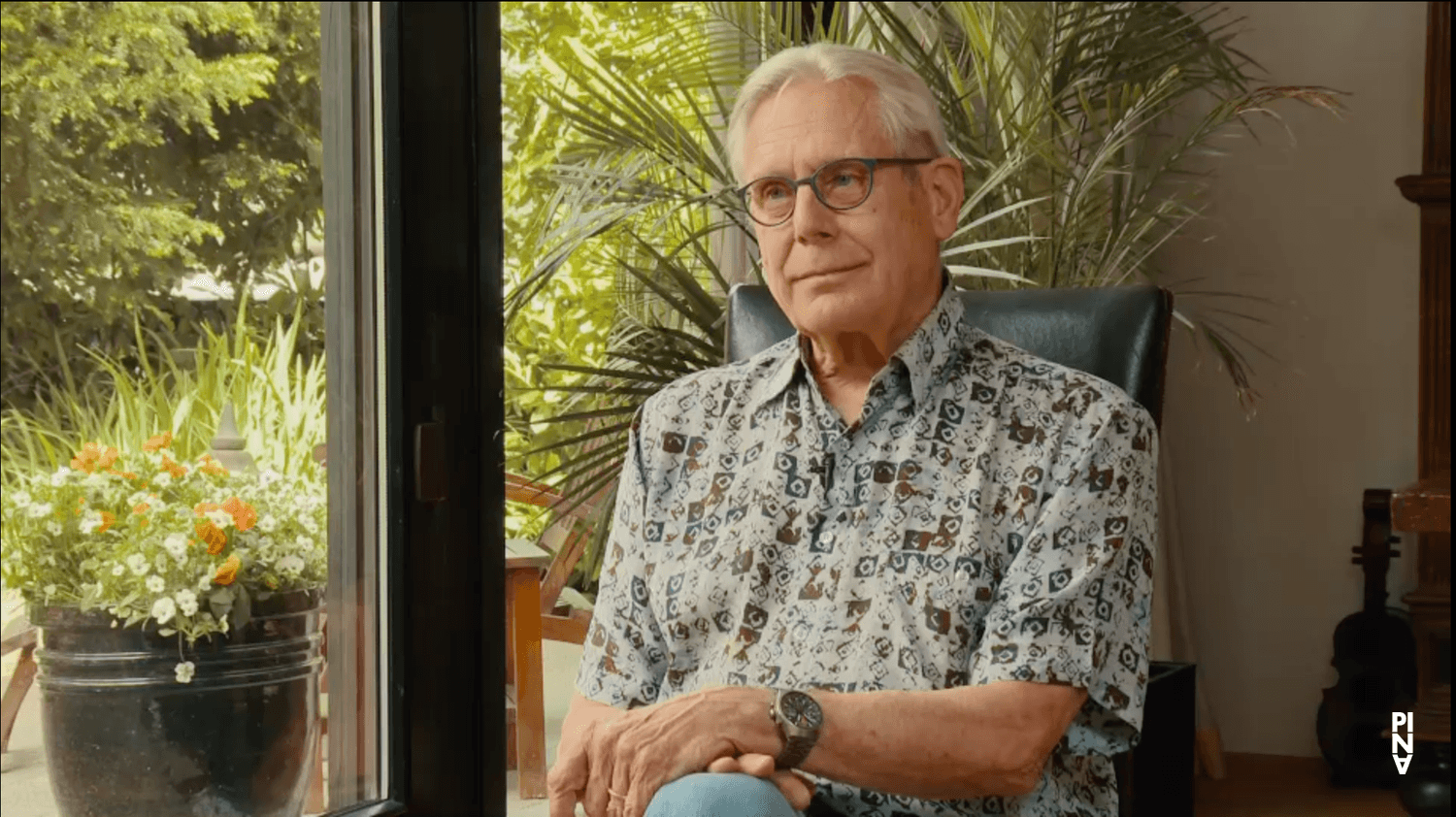
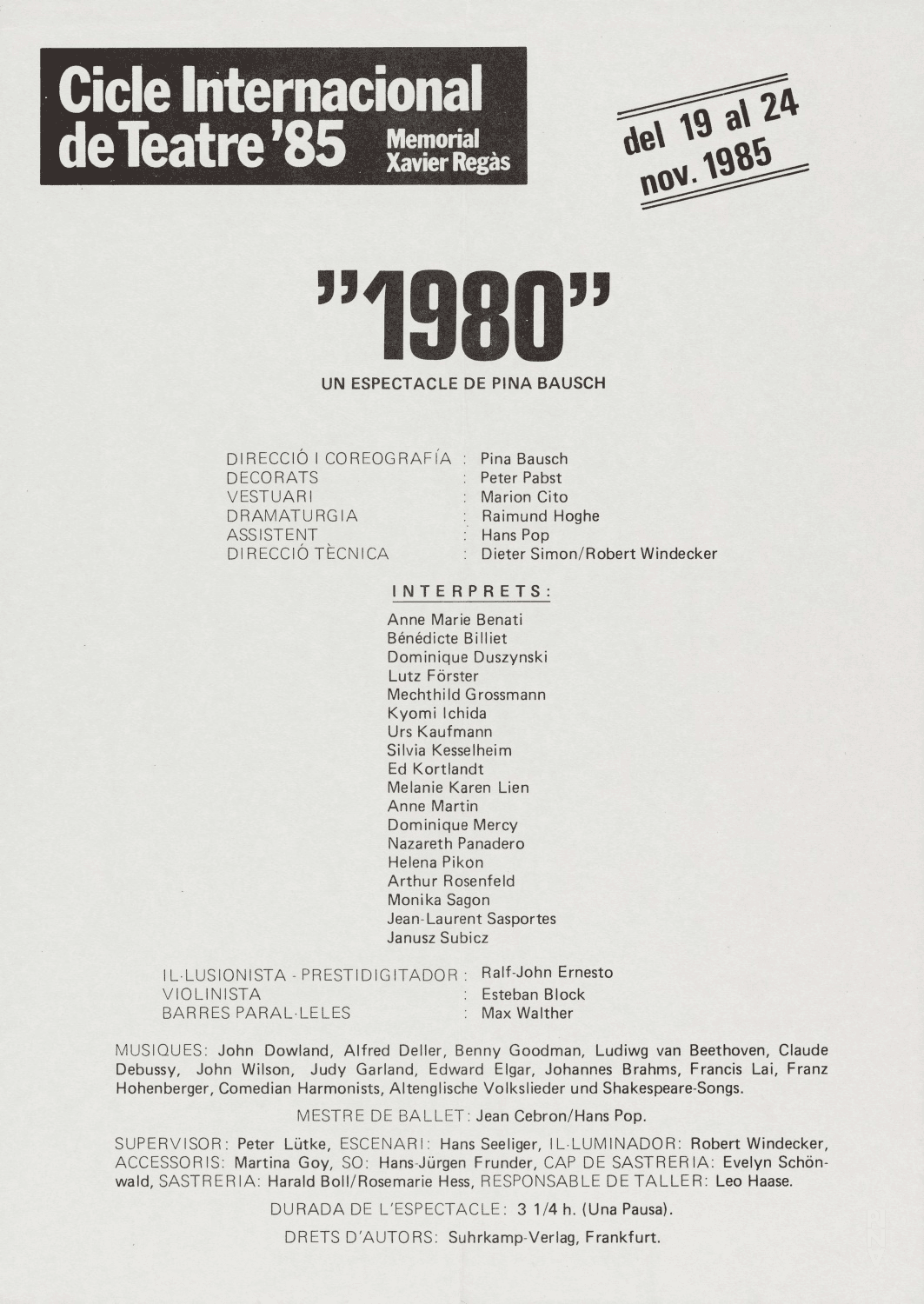

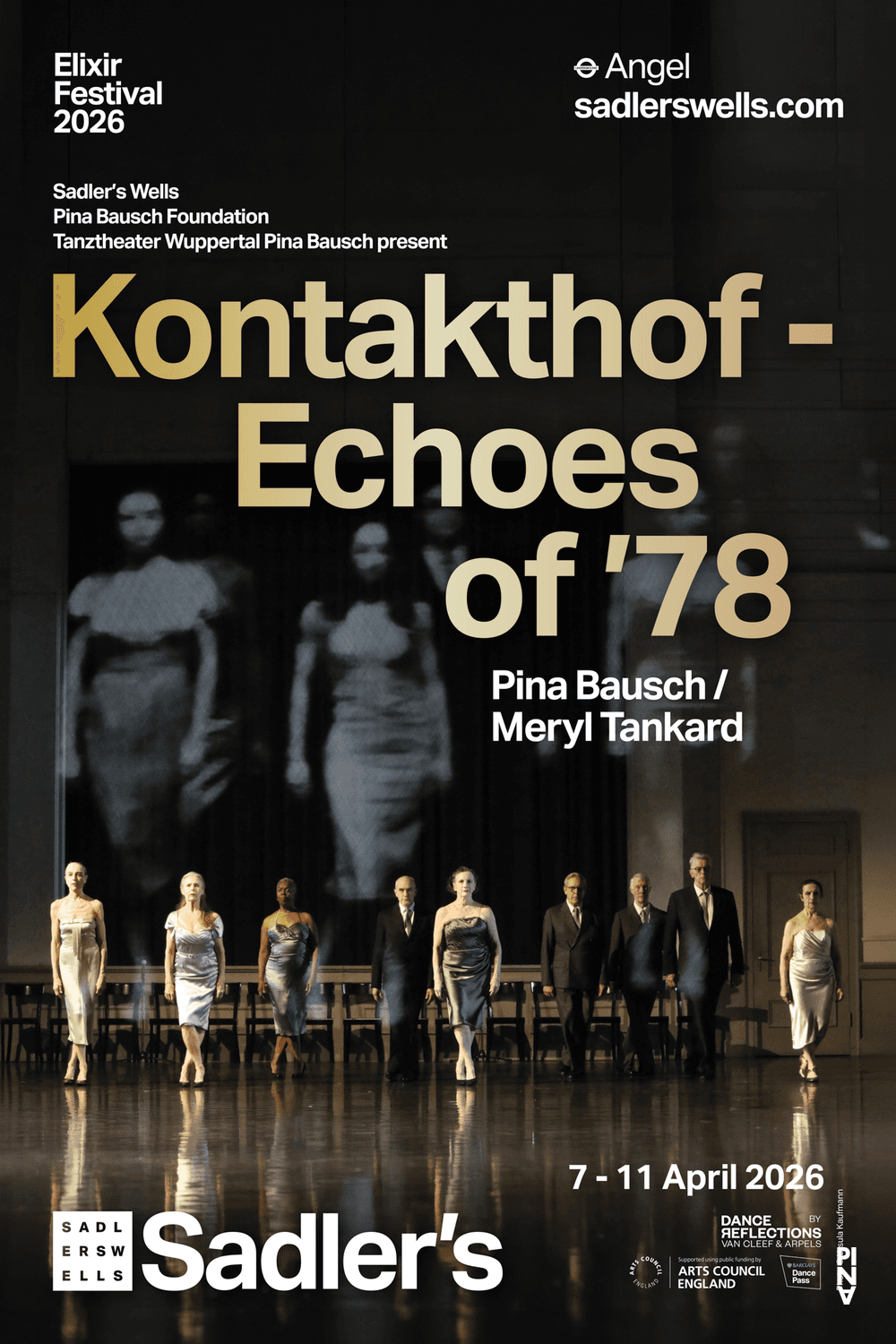
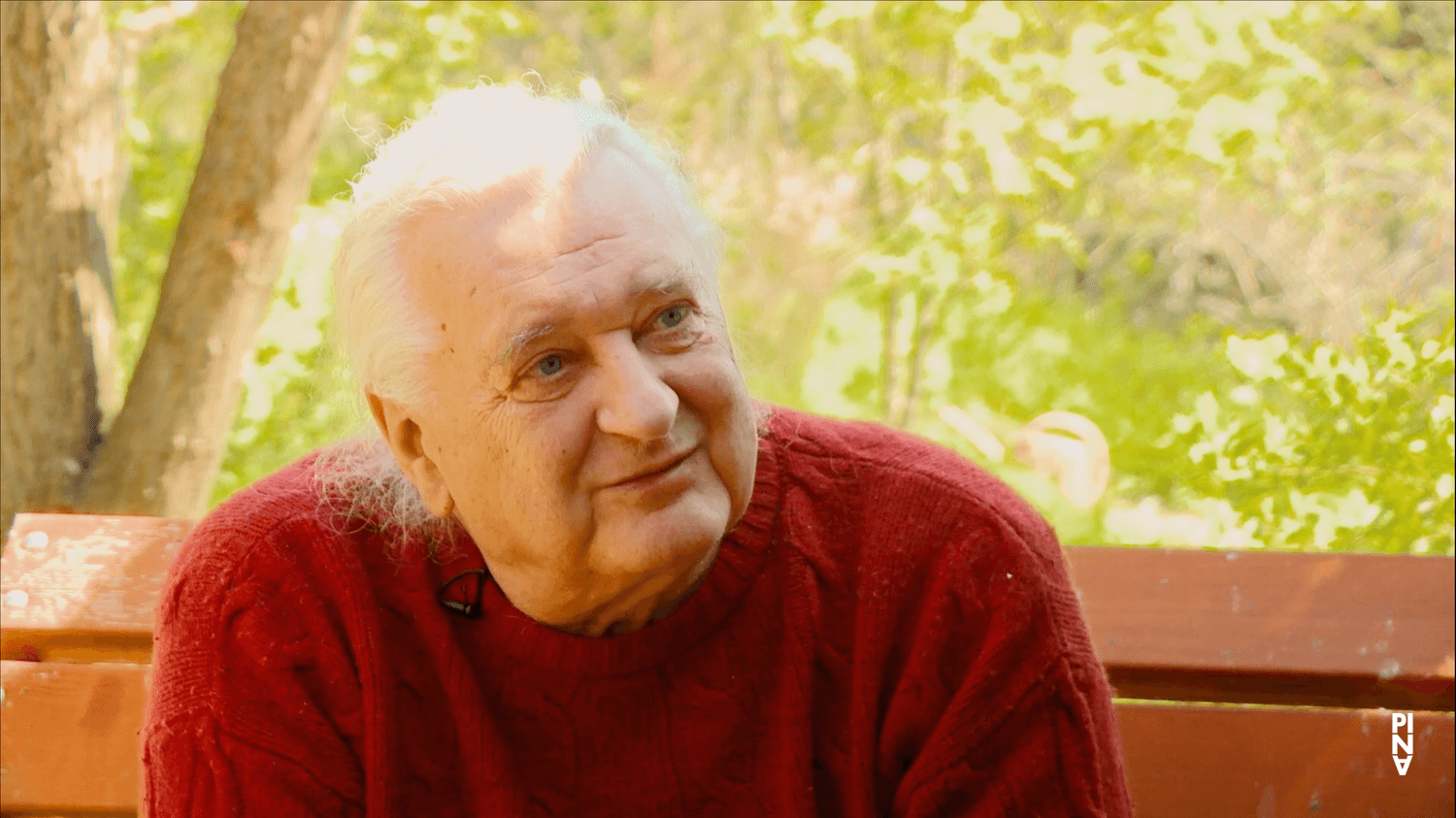
Legal notice
All contents of this website are protected by copyright. Any use without the prior written consent of the respective copyright holder is not permitted and may be subject to legal prosecution. Please use our contact form for usage requests.
If, despite extensive research, a copyright holder of the source material used here has not been identified and permission for publication has not been requested, please inform us in writing.